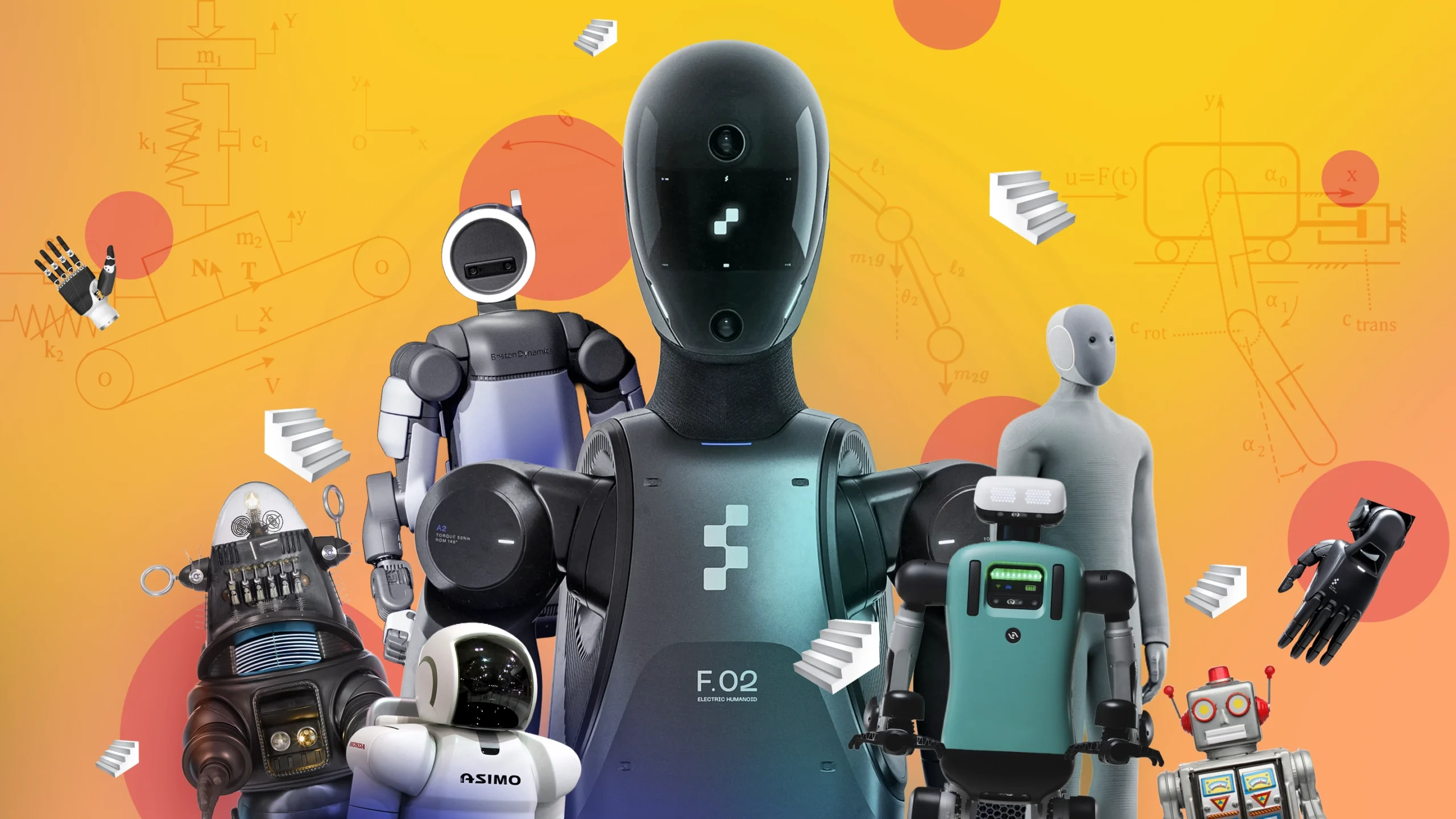
Companies are developing and now promoting a future full of humanoid robots.
[artificial intelligence](<https://www.quantamagazine.org/tag/artificial-intelligence>) [computer science](<https://www.quantamagazine.org/tag/computer-science>) [deep learning](<https://www.quantamagazine.org/tag/deep-learning>) [essays](<https://www.quantamagazine.org/tag/essays>) [machine learning](<https://www.quantamagazine.org/tag/machine-learning>) [neural networks](<https://www.quantamagazine.org/tag/neural-networks>) [physics](<https://www.quantamagazine.org/tag/physics>) [Qualia](<https://www.quantamagazine.org/tag/qualia>) [Quanta Podcast](<https://www.quantamagazine.org/tag/quanta-podcast>) [reinforcement learning](<https://www.quantamagazine.org/tag/reinforcement-learning>) [robotics](<https://www.quantamagazine.org/tag/robotics>) [The Quanta Podcast](<https://www.quantamagazine.org/tag/the-quanta-podcast>) [All topics](<https://www.quantamagazine.org/topics>)


Qualia: Essays that go where curiosity leads
The last time I covered the science of humanoid robots, the state of the art looked downright Orwellian — by which I mean, “four legs good, two legs bad.” It was 2015. Boston Dynamics’ first “Spot” quadruped had taken YouTube by storm, confidently trotting up stairs and recovering from vicious kicks. Also popular at the time: humanoids falling down. Constantly. I felt sorrier for those tottering metal lobsters than I ever did for Spot. Bipedal locomotion is hard.
Cut to now. Humanoids have apparently become so advanced that Tesla is mothballing some electric car models to make way for its Optimus humanoid robot, and start-ups are preselling android butlers with a straight face. Hype aside, I was genuinely curious: Did a paradigm shift happen in the field when I wasn’t looking? Sure, “AI” happened (that is, in the post-ChatGPT sense). I certainly hadn’t overlooked that. But I had no idea what it possibly had to do with robots not falling down anymore.
AI breakthroughs have made humanoid robots more capable than ever. But they still struggle with everyday tasks like stairs and doors.
For a reality check, I called Scott Kuindersma, who recently left Boston Dynamics after many years there, and Jonathan Hurst of Agility Robotics. Both scientists had been present and involved during the robot-faceplant days. Surely today’s robotic bipedal marvels can ascend a few stairs and open a door without breaking a nonexistent sweat, something they famously struggled with a decade ago. I asked each researcher: Can your flagship robot — Boston Dynamics’ Atlas or Agility’s Digit, two of the most credible and pedigreed humanoids on Earth — handle any set of stairs or doorway?
“Not reliably,” Hurst said.
“I don’t think it’s totally solved,” Kuindersma said.
Don’t get me wrong: I don’t believe that some sock-faced robot zombie is close to taking over my household chores. But stairs and doors? It’s 2026. Why are humanoids still this … hard?
To be fair, a paradigm shift did happen. Three, actually.
First, deep learning — neural networks running on fast GPU chips — turbocharged computer vision and reinforcement learning, which radically improved the speed and sophistication with which robots could perceive and interact with their environments. Then in 2016, a revolution in actuation (roboticist-speak for “making parts move”) began: Heavy hydraulic mechanisms were replaced by smaller, “proprioceptive” electric motors that gave legged robots animal-like nimbleness. Most recently came the large language models. Adapting chatbot technology for robots, it turns out, lets them autonomously plan and perform multistep tasks, such as coring an apple or emptying a dishwasher (in demos, at least).
n philosophy, “qualia” refers to the subjective qualities of our experience: what it’s like for Alice to see blue or for Bob to feel delighted. Qualia are “the ways things seem to us,” as the late philosopher Daniel Dennett put it. In these essays, our columnists follow their curiosity, and explore important but not necessarily answerable scientific questions.
These advances created the night-and-day difference between “Running Man,” the hulking, halting version of Atlas that won second place in 2015’s DARPA Robotics Challenge, and the svelte, smooth Atlas recently shown breakdancing and autonomously moving irregular items from one bin to another (while dealing with interference from a hockey stick–wielding human).
That fluid gait, for example, comes from deep reinforcement learning. Roboticists once coordinated each movement with various hand-engineered algorithms, using equations to model the (simplified) physics of the robot. Now they train neural networks to act as “whole-body controllers” by running countless digital simulations of the humanoid. This process teaches the network a “policy” for how to translate feedback from its environment into actions.
“We use reinforcement learning to build a policy that’s handling the body coordination, collision avoidance, balance, all that stuff,” Kuindersma said. There’s no longer any need to model a robot’s leg as a linear inverted pendulum, for example. “That’s just gone by the wayside,” he said.