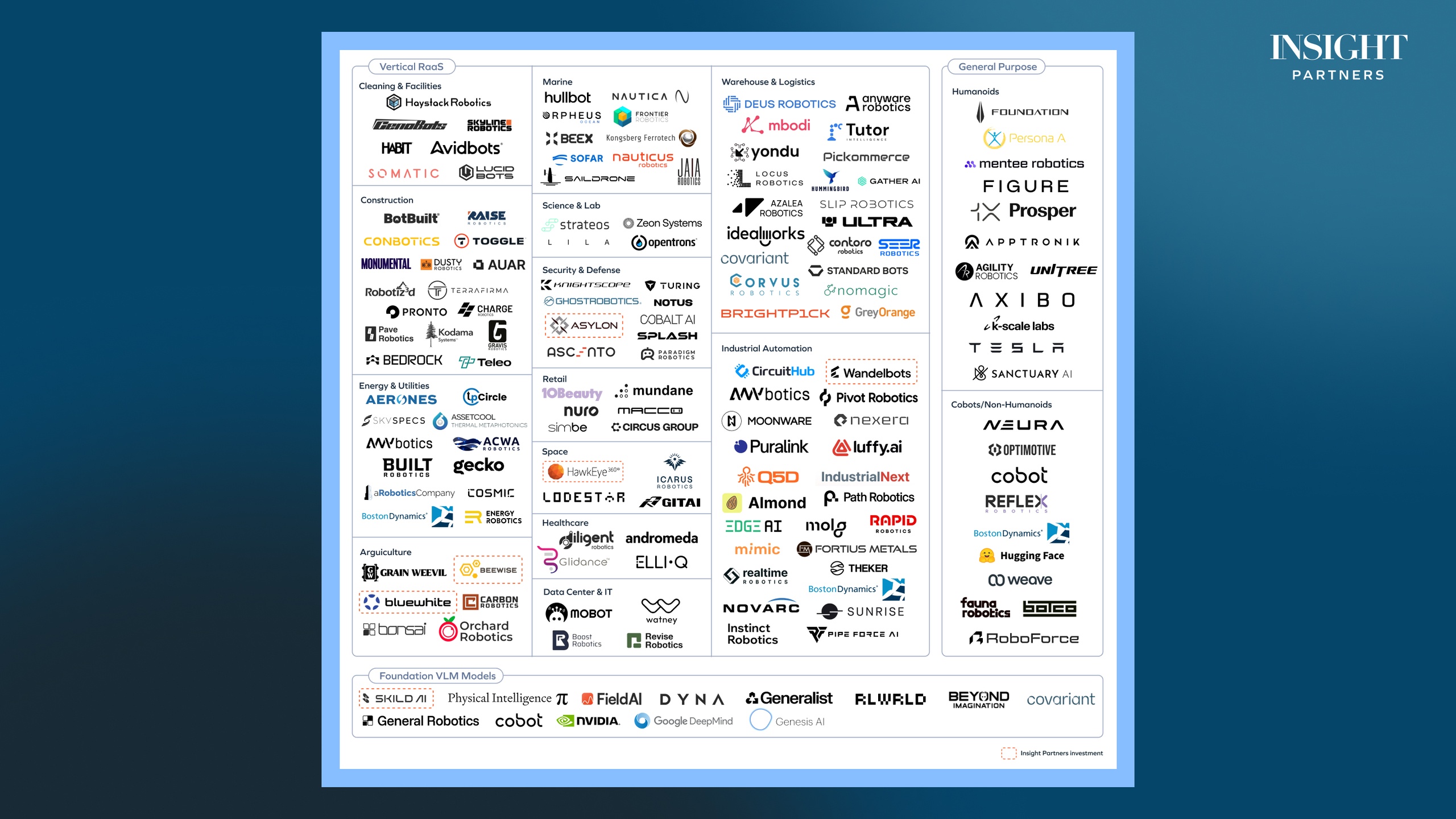
Application-level AI has rapidly transformed how humans interact with computers, from copilots in the enterprise to personal assistants in everyday life. But the next frontier isn’t just digital — it’s a physical world where intelligent robots become a “read/write API to physical reality.” AI agents are redefining productivity. Physical agents will redefine labor.
Progress in robotics’ foundation models — driven by advances in deep learning, richer training data from teleoperation and simulation, and cheaper hardware — is closing the gap between research and deployment. In this environment, vertical Robotics-as-a-Service (vRaaS) offers one possible path to commercialization for the next era of robotics, focused on solving specific, economically valuable tasks.
This perspective is informed by numerous conversations with researchers, startups, industry incumbents, and conversations within Insight Partners. This article covers the current state of the robotics ecosystem, including key technologies, commercial use cases, deployment challenges, and strategic pathways for scaling.
The history of robotics is a story of reinvention, with every generation shaped by advances in hardware, compute, and intelligence.
Initially, there was tightly constrained automation: hard-coded machines bolted to factory floors, repeating precise movements in controlled environments. These systems were useful only within narrow industrial applications and were largely rules-based — they followed explicit instructions rather than pursuing goals. The Unimate, for example, deployed at General Motors in the 1950s, represented an early commercial use of a robot arm capable of tasks like die-casting and welding.
In the late 2000s, mobile robots were equipped with sensors and simple planning algorithms. The PR2 robot demonstrated what was technically possible, even if it was, in some ways, commercially premature. The hardware could move and “see” but lacked the necessary compute for control and perception systems to operate reliably in unstructured settings.
The PR2 was one of the first robots to natively use the Robot Operating System (ROS), an open-source framework for managing robots. Engineers didn’t have to spend as much of their time re-writing code and building prototype test beds.
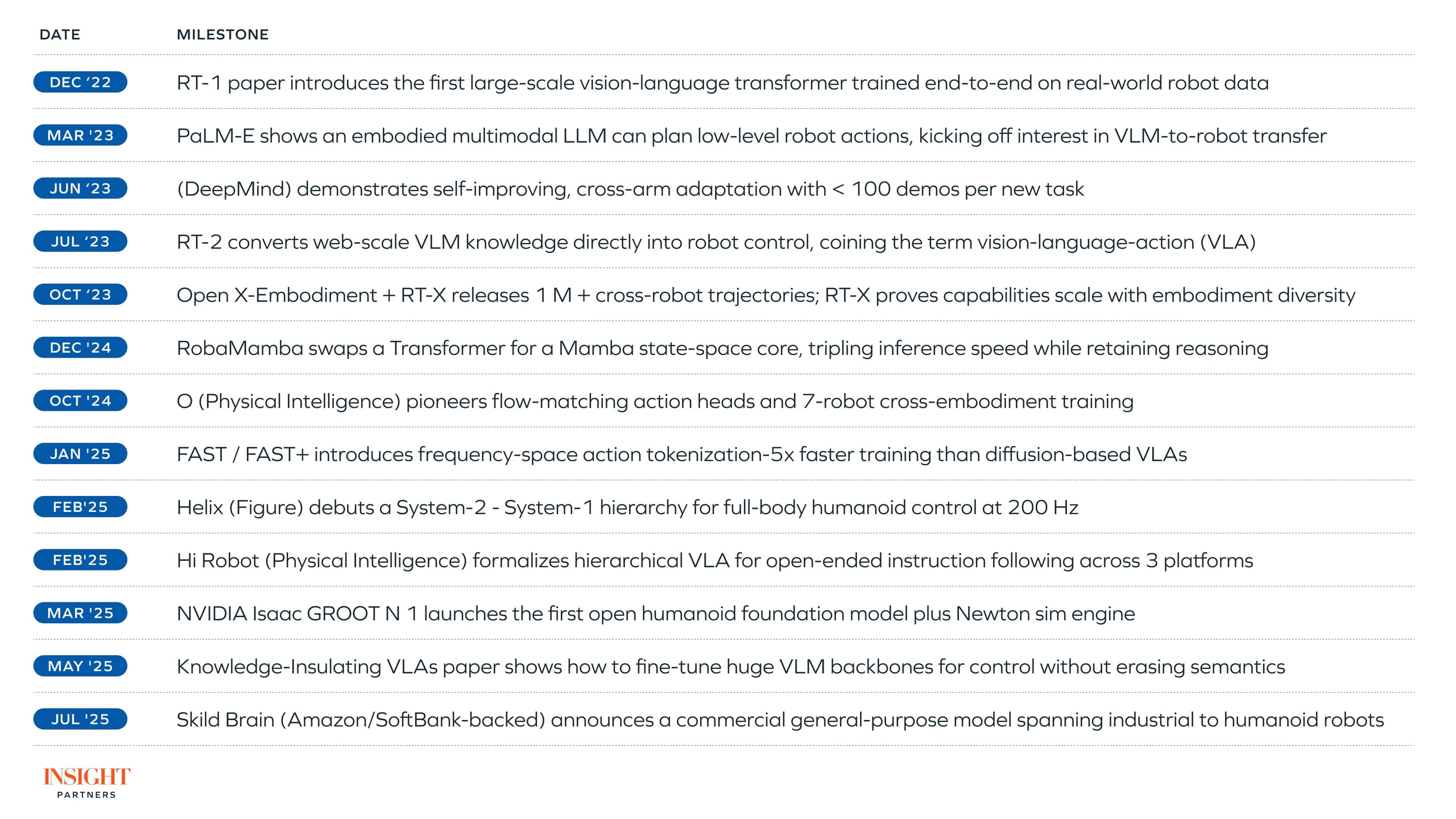
In the past decade, there have been rapid advances in both software and compute. Around 2015, breakthroughs in reinforcement learning, simulation (e.g. MuJoCo), and imitation learning allowed robots to gain motor skills through data rather than hard-coded rules. Data went into the system; robot software came out. Then came Transformers. By adapting similar architectures to those behind frontier large language models (LLMs), like OpenAI’s GPT, researchers trained vision-language models (VLMs) like RT-1, which understood and associated text descriptions with real-world images and videos.
VLMs evolved into vision-language-action (VLA) models like RT-2, which extended those multimodal representations to action space – allowing robots to apply knowledge learned from text, images, and video to physical tasks. Since then, progress has accelerated, with multiple research groups racing to build true adaptive learning models that can execute new tasks without retraining.
Today, billions of dollars are flowing into humanoid platforms (e.g., Tesla Optimus, Figure, 1X NEO, Agility, Unitree, and others) driven by the belief that humanoids are best suited to navigate a world designed for the human form and that robot manufacturing costs can be reduced by producing a single, versatile robot model at a large scale. At the same time, companies like Skild and Physical Intelligence are developing generalized “robotic brains” – robot AI software systems capable of adapting across a wide range of hardware form factors.
The gap between research breakthrough and commercial viability continues to shrink dramatically, and what once took years is now unfolding in months.
Generative AI agents like OpenAI Deep Research can understand goals, break them into steps, and carry them out with context for over 20 minutes without human input. Similarly, as foundation models adapt to the physical world, with robotics researchers building systems that echo the blueprint of LLMs, longer-running systems are a big prize. Making this vision real requires many advances.
One challenge is data scarcity. Scaling laws in LLMs have shown power-law reductions in model loss as dataset size increases, with similar performance gains observed when training with synthetic data. While the LLM community grapples with diminishing returns to pre-training data and is adding new techniques like building post-training reinforcement learning environments and inference-time compute scaling, robotics faces a more fundamental constraint: The complexity of the physical world makes collecting high-quality, pre-training data a bottleneck. As the Skild team observed, “A simple back-of-the-envelope math says that even if the whole population of Earth collects data, it will take years to reach 100 trillion trajectories.”
We see a few data acquisition strategies forming today: