The robotics sector raised a record $40.7B in 2025 — up 74% YoY and 9% of all venture funding — making it a funding leader alongside AI software.
Physical AI is driving this progress, enabling robots to operate in the physical world and learn from data rather than pre-programmed rules.
The race centers on building foundation models for robots to learn across tasks. Unlike language models trained on text, the physical AI models that power these systems require real-world robot data, creating an early window for market control.
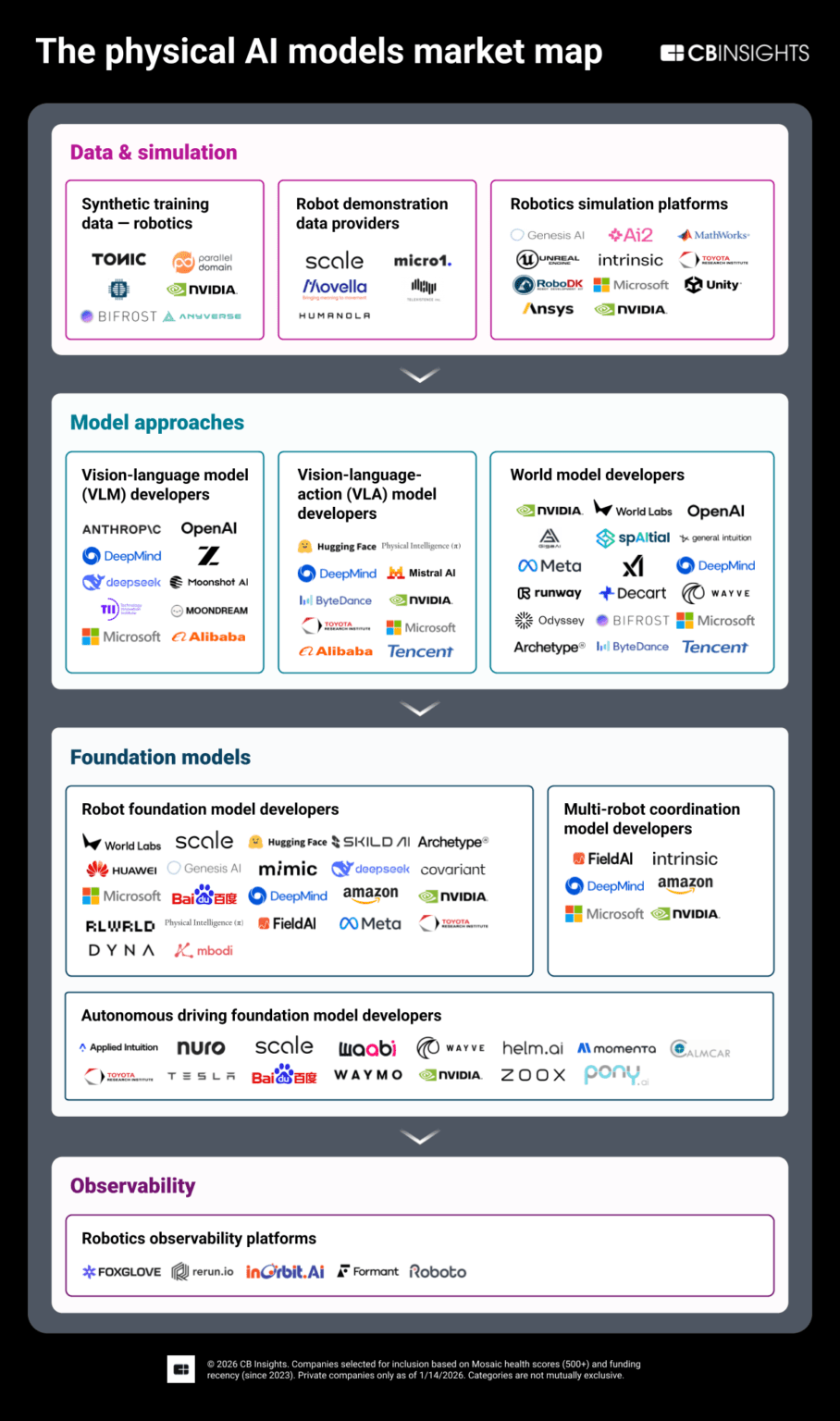
In the market map below, we identified 70+ companies across 10 physical AI model categories. We organized these companies into the following groups:
- Data & simulation: Synthetic data generation, real-world robot demonstrations, and simulation platforms where robots learn in virtual environments.
- Model approaches: Core AI architectures that enable robots to understand their environment (VLMs), generate actions (VLAs), and predict outcomes (world models).
- Foundation models: Pre-trained robot intelligence that combines various model architectures for general manipulation and inference, autonomous driving, and multi-robot coordination.
- Observability: Platforms that monitor deployed robots and feed real-world data back into training to improve performance.
*CB Insights customers can explore these companies here, sorted by their Mosaic health score.*
Click here for the Book of Scouting Reports on these companies
Please click to enlarge.
Note: This map includes leading public corporations and private companies with
*Mosaic scores above 500. Mosaic predicts the health and success likelihood of private companies. In markets with 5 or fewer companies, all companies were included. Companies may appear in multiple markets. This map is not exhaustive of the space.*
Key takeaways
- Proprietary training data is a critical competitive advantage for physical AI, with tech leaders racing to secure access through acquisitions. Nvidia acquired synthetic data provider Gretel for over $320M in March 2025. Meta took a $14.8B stake in Scale, a data infrastructure and model development provider. OpenAI attempted to acquire Medal for its training data before Medal launched General Intuition to build models from that data. Companies controlling exclusive training data can develop more capable models while forcing competitors to license access. Securing diverse, high-quality training data early will determine which players achieve commercial scale.
- World models enable robots to predict and plan autonomously — a capability beyond what large-language models (LLMs) can achieve. Investment in world models surged from $1.4B in 2024 to a record $6.9B in 2025, with companies in the space averaging a Mosaic score of 722 (the top 3% of all markets). But success requires quality training data from controlled environments and close partnerships with hardware manufacturers to ensure seamless performance in complex real-world tasks.
- **Multi-robot coordination remains the critical missing piece in physical AI.** Despite the two global foundation model leaders racing ahead with single-robot approaches — US companies raised over $17B across 17 deals while Chinese companies raised $416M across 15 deals — both focus almost exclusively on individual robot capabilities. Few companies are building the orchestration layer needed to manage multiple robot types working together. Whoever solves coordination first can control how autonomous robot fleets scale across industries.
Category overview
DATA & SIMULATION