
There’s a new aspiration in startup pitch decks: “We’re basically Palantir, but for X.”
Founders talk about embedding forward-deployed engineers (FDEs) with customers, building deeply customized workflows, and operating more like a special-forces unit than a traditional software company. Job postings for “forward-deployed engineers” are up hundreds of percent this year as companies copy the model that Palantir pioneered in the early 2010s.
I get why this is attractive. Enterprises are feeling seriously overwhelmed when considering which technology products they should buy off the shelf; everything now markets itself as AI, and it’s never been harder to parse signal from noise. The Palantir pitch — parachute a small team into a messy environment, wire together homegrown, siloed systems, and ship a customized working platform in months — is compelling. And for a startup trying to win its first seven-figure deals, “we’ll send engineers to sit inside your org and make this work” is a powerful promise.
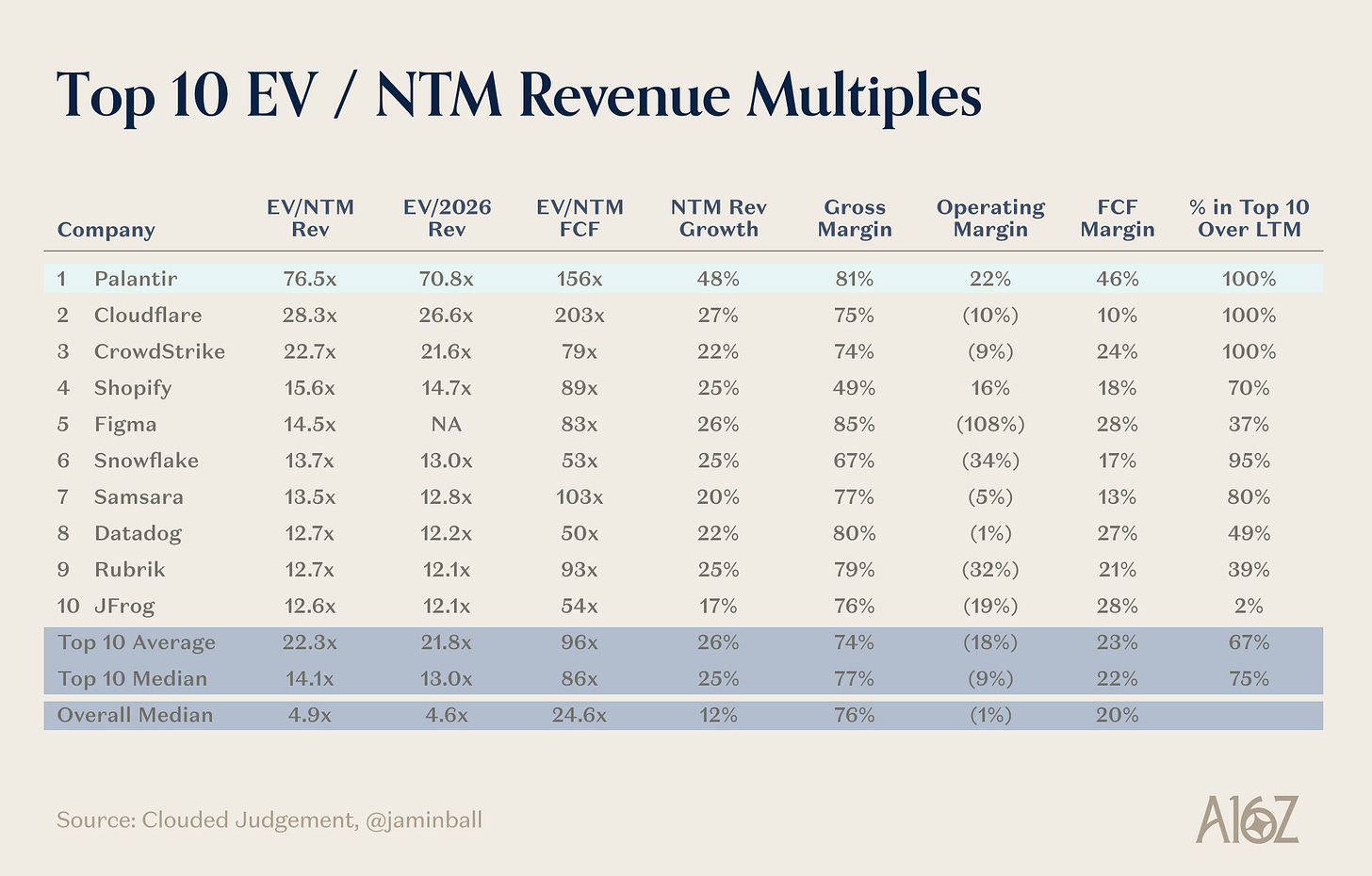
But I’m skeptical that “Palantirization” scales as a universal playbook. Palantir is a “category of one” (just look at how it trades!), and most companies copying the aesthetic are setting themselves up to become expensive services businesses with a software valuation multiple and no compounding competitive advantage. It kind of reminds me of how every startup pitched itself as a “platform” in the 2010s, when there are in fact very few true platform companies due to how difficult they are to build!
This post is an attempt to separate what’s actually portable in the Palantir model from what’s idiosyncratic — and to offer a more pragmatic blueprint for founders looking to pair enterprise software with high-touch delivery.
“Palantirization” has started to mean a few related things:
Forward-deployed, embedded engineeringForward-deployed engineers (“Deltas” and “Echoes” in Palantir’s internal jargon) sit inside the customer’s organization (often for months), to understand domain context, stitch systems together, and ship custom workflows on top of Foundry (or Gotham in higher-security situations). Since pricing is fixed fee, there are no “SKUs” in a traditional sense. Engineers are responsible for building and maintaining those capabilities.
Highly opinionated, integrated platformUnder the hood, Palantir’s products are not a toolkit of loose components. They’re opinionated platforms for data integration, governance, and operational analytics — closer to an operating system for an organization’s data. The stated goal is to convert fragmented data into real-time, high confidence decisions.
Upmarket, high-touch GTM“Palantirization” also describes a go-to-market style: long, high-touch sales cycles into mission-critical environments (e.g. defense, policing, intelligence). Regulatory complexity and the magnitude of the “stakes” in the industry are features, not bugs.
Outcomes, not licensesRevenue is driven by multi-year, outcome-aligned contracts where software, services, and ongoing optimization blend together. Engagements can be worth tens of millions of dollars per year.
A recent analysis of Palantir framed it as a “category of one” because it simultaneously excels at: (a) building integrated product platforms, (b) embedding elite engineers in customer operations, and (c) proving itself in mission-critical government and defense environments. Most companies can manage one of these, maybe two — not all three at once.
Yet in 2025, everyone wants to borrow the brand halo of this model.
Three big forces are converging: