The Hidden Structure Behind Today’s Fastest Startups from NFX
The Hidden Structure Behind Today’s Fastest Startups from NFX
You’re building in the most explosive company-design shift in decades — but most founders are still acting like nothing has changed.
AI reshaped what one person can do, and it’s forcing startups to rethink every assumption about hiring, structure, leadership, and speed. The teams pulling ahead organize themselves differently from day one.
For a century, status and compensation rose with the number of people you managed. In the AI era, it rises with how well you manage AI. That flips the entire design of the company.
Founders often treat structure as fixed. In reality, org design is fluid. It bends to two forces: the technology moment you’re building in and the competitive pressure you face. Right now, that moment is AI. And winning means maximizing three things: your ability to ship, innovate, and create. Anything in your structure that slows you down is poison.
The companies already breaking out have made fundamental shifts in how they organize themselves internally. Here’s what they’re doing differently — and how you can think like them.
The most successful companies engineer structures that inherently facilitate the culture they require. If you need control and oversight, you should structure your company very differently than if you need speed and creativity.
The origin story of the org chart itself shows the relationship between technology windows, competitive advantage, and organizational structure well.
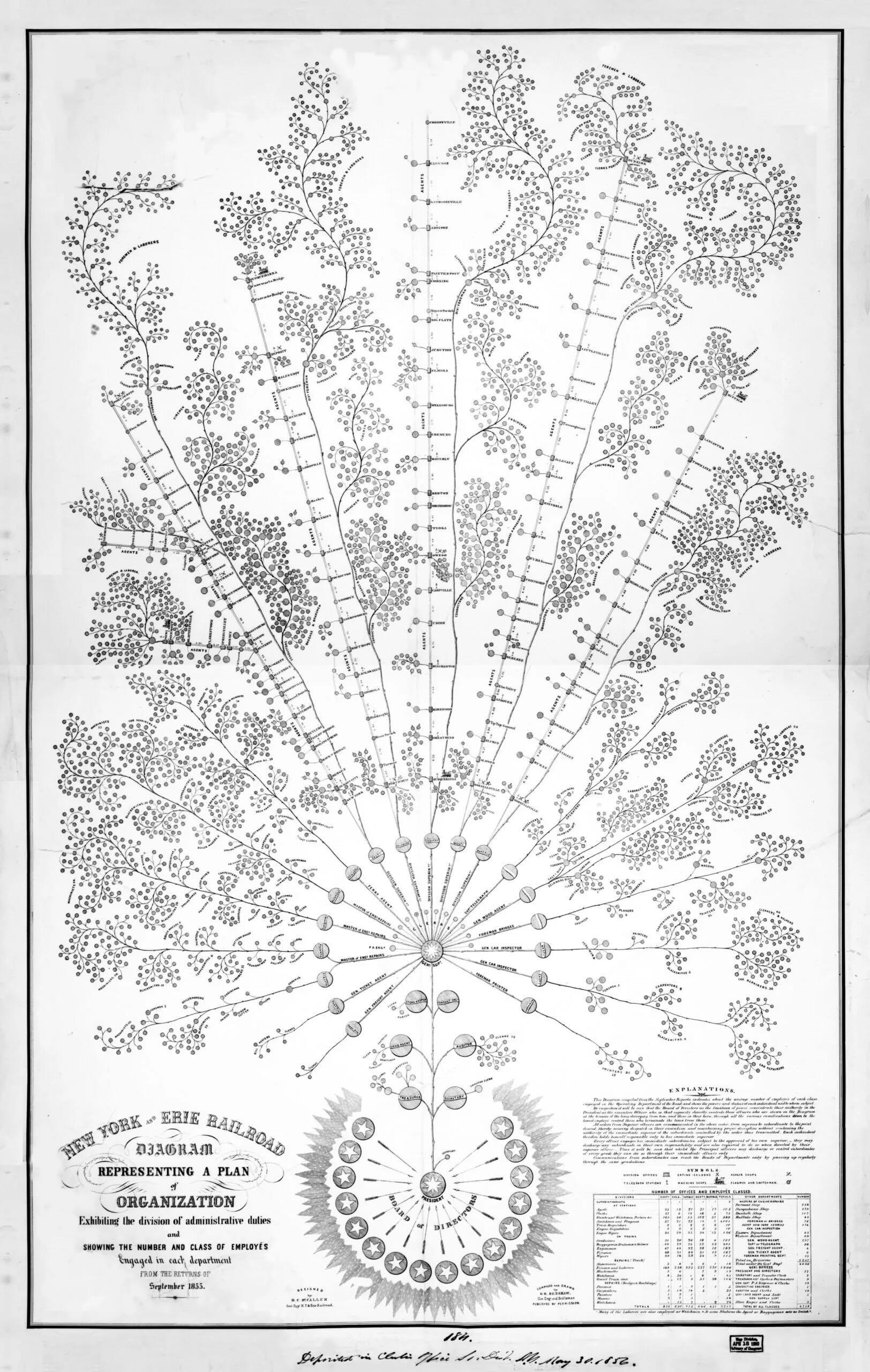
In the 1850s, the New York and Erie Railroad was one of the largest railroad networks in the country, but it teetered on the edge of chaos. As expansion pushed the system past 500 miles of track, the logistical challenge of coordinating trains, and maintaining lines outstripped the company’s ability to manage.
Daniel McCallum, an engineer and eventually the railroad’s general manager, solved the problem. His breakthrough was the first modern organizational chart, completed in 1855.
The chart, designed like a tree, mapped the entire company, showing which lines of responsibility tracked from the board down to the front lines. This structure created a shared sense of command, transparency and control. It allowed him to tame this sprawling network.
The org chart itself isn’t a stunning breakthrough, but it shows how elegant company structure can actually solve massive problems (in this case, issues of life and death).
The Hidden Structure Behind Today’s Fastest Startups from NFX
The Hidden Structure Behind Today’s Fastest Startups from NFX
When it comes to structuring your company, form follows function. The key is realizing what the “function” you need to prioritize actually is.
Often, that core function is related to technology and competition. McCallum knew the railroad game was about efficiency and coordination. That was how you won back in 1855. The company structure was created to prioritize that function – but it came with tradeoffs. Such a strong hierarchy, for example, is slow-moving, and unlikely to innovate quickly.
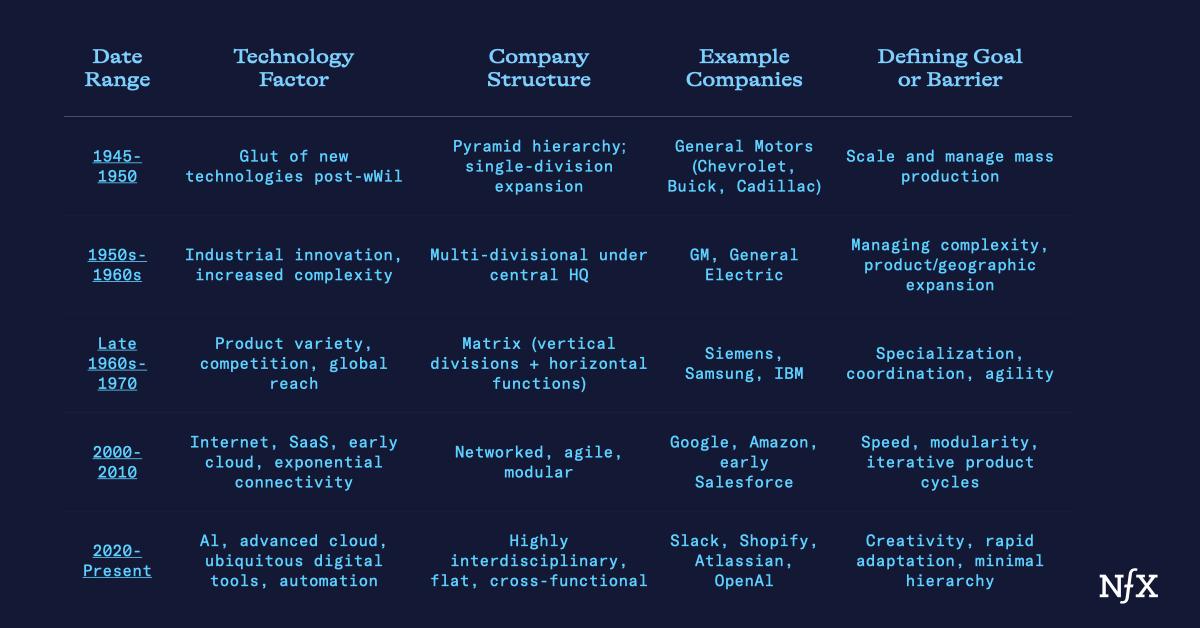
Your company structure needs to reflect what traits your company needs to win. Here are some examples of technology shifts, and how they affected company structure:
The Hidden Structure Behind Today’s Fastest Startups from NFX
The Hidden Structure Behind Today’s Fastest Startups from NFX