
https://www.googletagmanager.com/ns.html?id=GTM-KJSJS66
https://www.googletagmanager.com/ns.html?id=GTM-NQZSJM
Photo of overlapping water ripples
As the age of AI takes hold definitively, its massive computational demands and soaring energy consumption have become pressing global challenges. One promising solution is an approach known as reservoir computing. Compared to neuromorphic devices—which mimic the cerebrum and are designed for universal utility—reservoir computing models the cerebellum and draws on natural phenomena, enabling fast and energy-efficient processing. Jointly with Hokkaido University, TDK has developed a prototype analog reservoir AI chip designed for edge applications. At CEATEC 2025, to be held in October 2025, visitors will have the opportunity to experience the technology firsthand on live demonstration devices.
The rise of generative AI is transforming everyday life and industries alike. But alongside its adoption, unavoidable challenges have become increasingly conspicuous. AI’s heavy dependence on cloud computing is creating network congestion and latency, while power consumption in data centers continues to skyrocket. For applications requiring real-time responsiveness, including robotics and human interfaces, a cloud-only approach is beginning to reveal its limitations. To unlock AI’s full potential across society, addressing energy consumption and latency issues by balancing the use of cloud and edge computing is an essential strategy.

Image photo of the use of generative AI
Reservoir computing presents a compelling possibility for addressing these issues. Conventional deep learning consists of an input layer; multiple intermediate layers where data is iterated in stages; and a final output layer. Adding layers enables more complex computation but demands exponentially more processing and thereby power—and inevitably creates more latency.
Reservoir computing, in contrast, consists of just three layers: input, reservoir, and readout. What’s distinctive is the reservoir layer. Instead of carrying out complicated calculations, it harnesses natural phenomena that unfold over time, like ripples on water surfaces or fluctuations in electrical signals. By capturing inputs from natural phenomena through features generated by their propagation and cross-interference, the system dramatically reduces the number of parameters needed for training. The result is faster, more energy-efficient computation compared to conventional methods.
Deep learning and reservoir computing compared
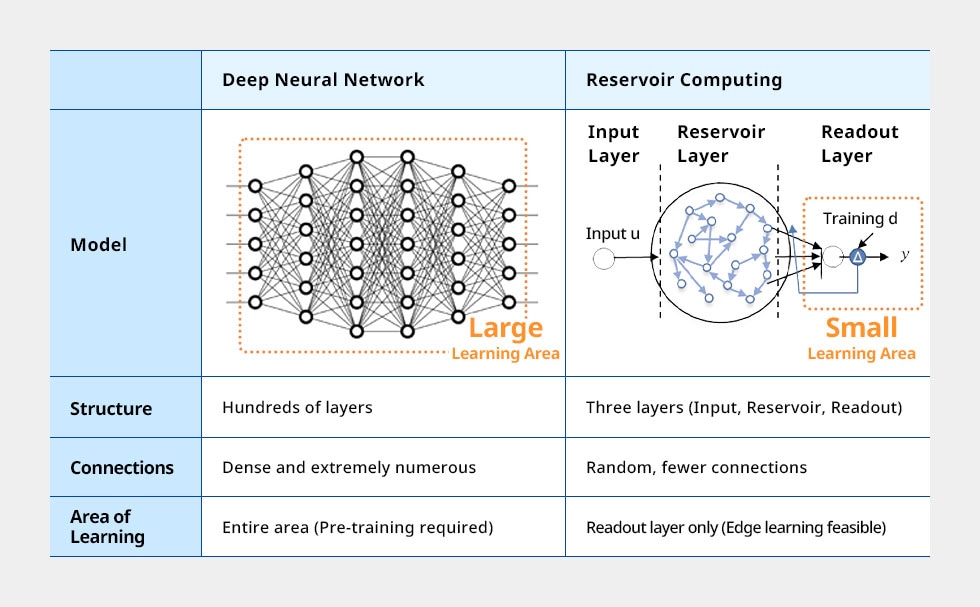
Comparison of deep learning and reservoir computing
Because reservoir computing devices are simple in structure and learning only takes place in a small area, high-speed computation is possible while saving power.
TDK and Hokkaido University set out to implement reservoir computing in analog electronic circuits and, in 2024, successfully created the world’s first prototype analog reservoir AI chip. This achievement builds on earlier work in 2020, when the team developed a large-scale reservoir computing device entirely composed of basic electronic components like capacitors and transistors. By physically reproducing large numbers of processing nodes, the circuit itself functioned as the computing resource—and its performance characteristics were confirmed to be the highest in the world. The new prototype integrates this approach into a compact chip, reducing power consumption to a level suitable for practical applications.

Analog reservoir AI chip (prototype) jointly developed by TDK and Hokkaido University