
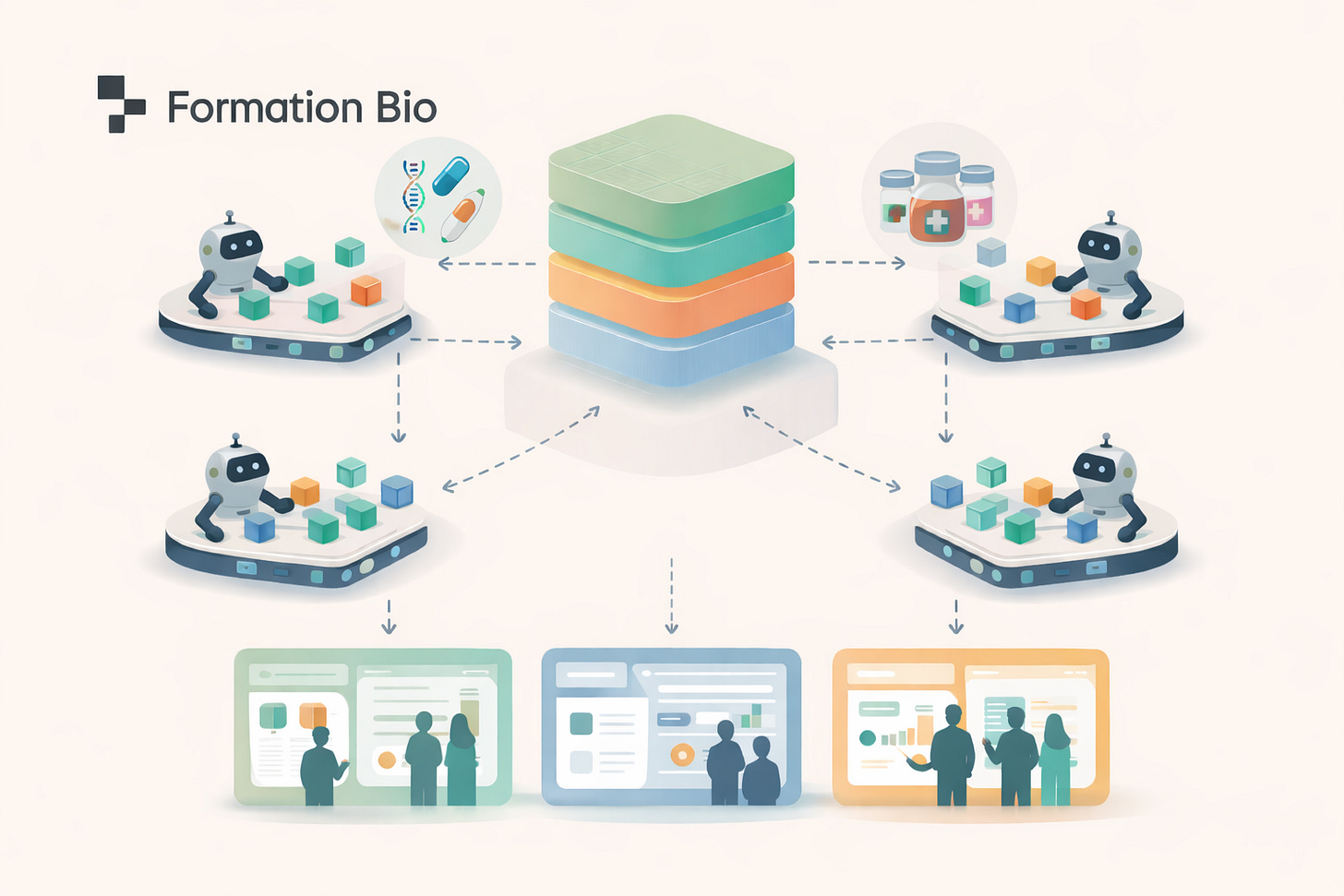
Formation Bio is building an AI native pharmaceutical company structured to make drug development faster, cheaper, and more predictable.1 The company has raised more than $600M. It licenses promising drug assets, then runs them through an integrated development engine that uses data and modern software to remove common bottlenecks across clinical planning, trial execution, and regulatory work.
In this interview, we speak with Dan Neil, CTO of Formation Bio, about what it means to build a truly AI-native biopharma company and why clinical development, not discovery, may be where AI can have the greatest near-term impact.
In this conversation, we discuss:
Origins in TrialSpark
Founders Benjamine Liu and Linhao Zhang started TrialSpark in 2016 to modernize clinical operations, building tools for digital recruitment and site management used by partners such as Novartis, Pfizer and Sanofi. Realizing that more efficient clinical execution changes the economics of drug development, the team began acquiring assets and rebranded as Formation Bio in 2023 to combine platform and asset ownership.2
Becoming Formation Bio
More efficient trial execution fundamentally changes the economics of drug development. If a company can run more trials per dollar and per unit time, it gains a structural advantage not just as a service provider, but as a drug developer. With the confidence that its platform could materially outperform traditional development models, TrialSpark decided to develop assets themselves, transitioning into an integrated pharma company and later rebranding as Formation Bio in 2023.3
Formation Bio’s hub-and-spoke model
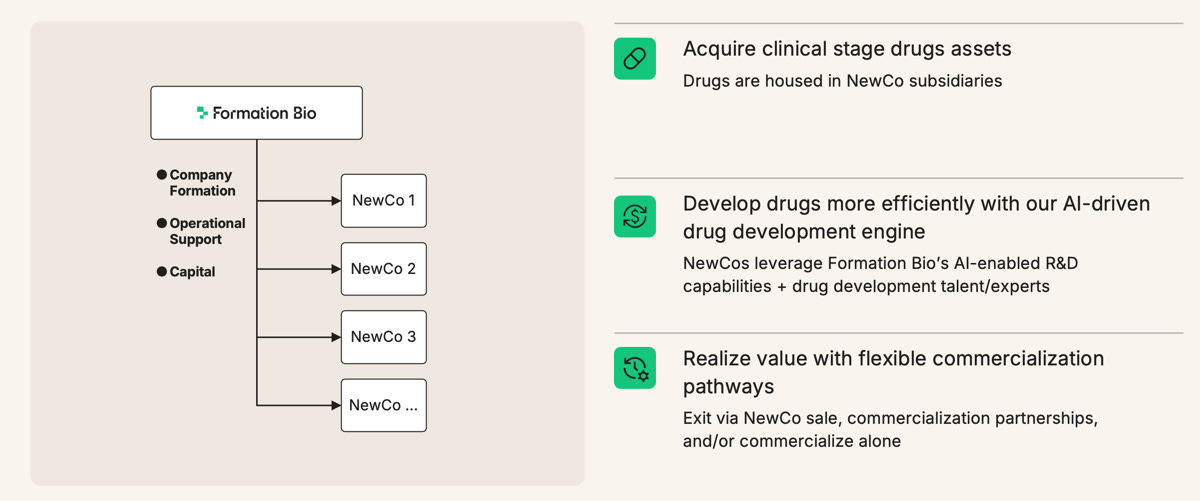
Formation operates as a hub-and-spoke model, where new assets are in-licensed or acquired and structured under subsidiary companies.4 This helps manage portfolio risk while allowing Formation to apply their more efficient drug development processes to each drug in their pipeline. The company raised a $372M Series D in 2024.