This week we feature a cross post from the Deep Forest Sciences blog that discusses how to use Prithvi to run no-code molecular dynamics (MD) simulations.
Molecular Dynamics (MD) is a computational method used to study the physical movements of atoms and molecules, such as proteins and nucleic acids, at the atomic level. The technique simulates the movement of atoms over time based on the interactions and forces between them, following Newton's laws of motion.
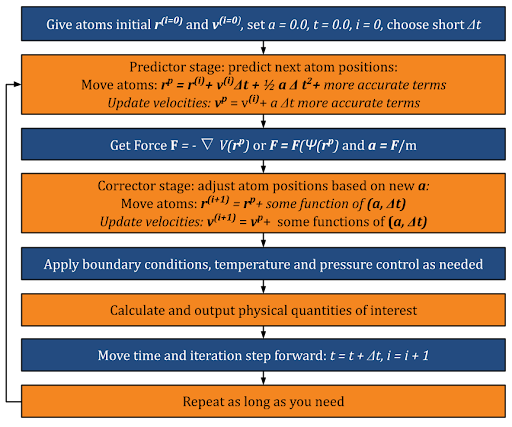
Molecular systems are complex and can consist of vast number of atoms and molecules. Analytically predicting the properties and behaviors of these systems under various conditions is extremely challenging. MD simulations avoid analytical solutions by numerically integrating Newton's equations of motion to model the trajectories of individual atoms. At each step, the method calculates the forces exerted on each atom by all other atoms in the system and iteratively updates their positions and velocities over time. Molecular dynamics is considerably more efficient, and can handle larger systems and longer simulation times, than quantum mechanical simulation methods. At the same time, it is far slower than coarse-grained models of pathways, cells or tissues from systems biology.
MD simulations use force fields, mathematical models of the potential energy surfaces of molecules. Forces are computed by computing the negative gradient of the potential energy. Force fields include parameters for bond lengths, angles, and non-bonded interactions such as van der Waals forces and electrostatic interactions. The simulation process involves dividing time into small steps (typically at the femtosecond scale), during which the forces on each atom are computed and their positions and velocities are updated accordingly. This iterative approach allows researchers to capture the time-dependent evolution of molecular systems.
A simplified schematic of the molecular dynamics algorithm.
Molecular dynamics simulations have recently found greater use in drug discovery. For example, a recent article demonstrates how MD simulations provide a powerful complement to experimental methods. MD simulations can help identify the binding modes of potential drugs with their target proteins. Additionally, MD simulations provide information on how proteins change shape and interact with other molecules in their environment. This can be used to better understand the function of proteins and design drugs that modulate their activity. MD simulations can aid in virtual screening by helping to identify alternative binding poses. Experimental techniques like NMR spectroscopy and fluorescence quenching which validate the predictions of MD simulation remain critical, but simulations are slowly becoming useful predictive tools[1].
Advances in computational power and the availability of open source software are powerful trends driving adoption of molecular dynamics. However a number of practical challenges remain to broad adoption. Several research efforts have integrated machine learning with MD simulations to improve accuracy of simulations and enable the prediction of unsampled molecular configurations [2]. In addition, MD simulations remain computationally expensive and generate vast amounts of data, making it challenging to analyze and identify key molecular behaviors.
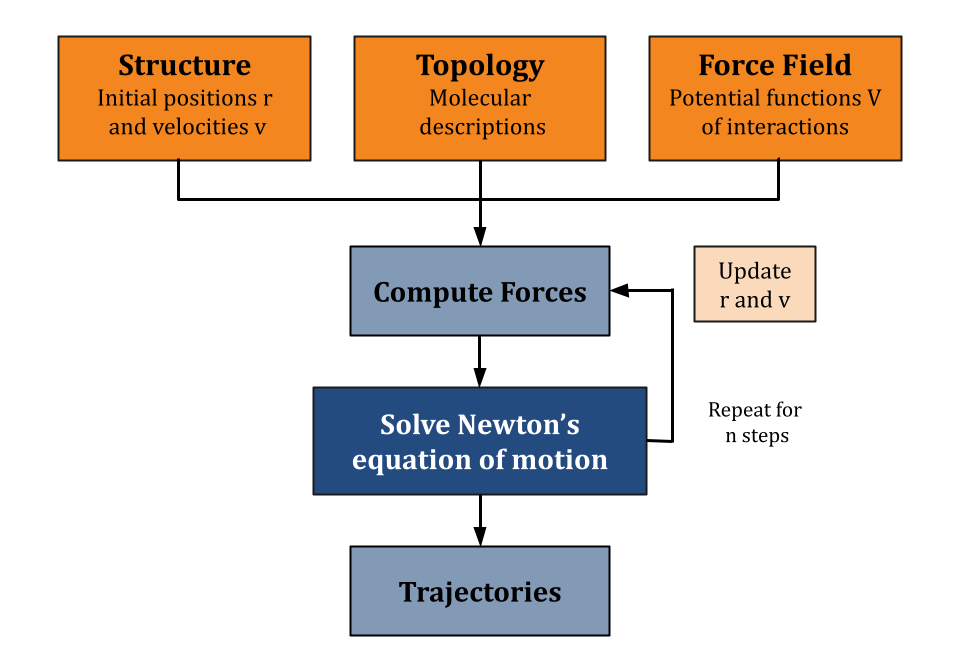
Effectively using molecular dynamics simulations involves complex and time-consuming calculations and often requires advanced computational skills. Prithvi™ provides a no-code platform for biologists and chemists to run molecular dynamics workflows to simulate and analyze molecular interactions without needing such expertise. Prithvi™ simplifies the entire process of MD simulations and allows the users to upload molecular data, select suitable force fields, control temperature and pressure, and configure other parameters as they require.
The standard workflow for molecular dynamics simulations.
Prithvi™ is our AI-powered platform to accelerate small molecule drug discovery with scientific foundation models. Prithvi™ has the ability to