
Representative image. | Finance Saathi.
It is well understood that state-level incentives are independent of the Centre’s incentives and that industry players are free to establish operations in the state of their choice. Prime Minister Modi also called for “engage in healthy competition with one another to build semiconductor ecosystems and enhance the investment climate within their regions”.
Introduction
Indian states actively engage in a competitive landscape to attract semiconductor investments, recognising the sector’s transformative potential to reshape their industrial landscapes and generate high-quality employment opportunities.
Semiconductor is a new buzzword in the geopolitical contest between the great powers, which was recently weaponised by the American President Donald Trump, and thenby the Chinese, to control the highly sophisticated technology in the world.
In this great power competition, aspiring global powers such as India have a sweet spot to attract global semiconductor companies to establish their fab units and jointly manufacture chips on Indian territory.India’s journey to the semiconductor industry, which began in the mid-1980s, has had its ups and downs, and is now entering the maturing phase, creating its own manufacturing ecosystem. Prime Minister Narendra Modi has accelerated the semiconductor manufacturing ecosystem in the post-COVID period through massive investments and joint-venture Memoranda of Understanding (MoU) signed between Indian companies and global players. During the SEMICON India 2025, Prime Minister Narendra Modi said, “Our journey is late, but nothing can stop us now…India is now moving from backbend to becoming a full-stack semiconductor nation. The day is not far when India's smallest chip will drive the world's biggest change... the day is not far when the whole world will say - designed by India, made in India, Trusted by the world.”
In total, there have been ten semiconductor projects worth approximately $18 billion (more than ₹1,59,00 crores) in investment commitments and over $7 billion (nearly ₹62,000 crores) in subsidies allocated since the Prime Minister initiated the expansion of its manufacturing fabs. In addition to this, 23 chip design projects have been sanctioned, a new technical curriculum has been designed, and over 60,000 students or trainees have participated in the training programs organised by the government.
The entire fab ecosystem has expanded and transformed from a virtually non-existent presence to a massive, multi-project initiative with ten projects in the last four years. India recently announced ventures for a compound fab and advanced electronic packaging. Under these projects, chips will be manufactured, assembled, and packaged primarily within the 28-110 nm range, which will be beneficial in various everyday applications, including consumer products, electronics, the automotive sector, computing, data storage, and wireless communications.
The target is to manufacture and sell it in the domestic market, as well as export it globally. According to Fortune Business Insights(2025), “The global semiconductor market size was valued at over $681 billion in 2024 and is projected to grow from over $755 billion in 2025 to more than $2,062 billion by 2032, exhibiting a CAGR of 15.4% during the forecast period (2025-2032)”.
However, India’s efforts to create a chip manufacturing ecosystem have seen ups and downs in its 40-year history. For instance, in its semiconductor journey, in 1984, it established the Semiconductor Complex Limited (SCL) in Chandigarh, securing licensing agreements from Hitachi, AMI, and Rockwell. In 1985, Metkem Silicon Ltd., supported by BEL, set up polysilicon facilities in Mettur, Tamil Nadu. In 1989, a fire at SCL severely damaged the Chandigarh facility, affecting its output for ISRO and other projects. Then, in March 2007, India announced its first Semiconductor Policy, targeting ₹24,000 crore in investment and the establishment of three semiconductor fabrication facilities. All these efforts failed due to policy failures and the government's lacklustre behaviour in these sectors.
The great power competition in the technological domain, particularly between the US and China, which began in the mid-to-late 2010s, has created vulnerabilities in the global market for high-technology sectors. This is exemplified by the Trump-led 2019 restrictions on American chips to China and the pressure on ASML not to export to China. The COVID-19 disruptions in the global chip supply chain and related risks convinced the Modi government to invest heavily in this sector, including a 70 per cent capital subsidy for Micron to build a semiconductor assembly and testing plant in Sanand, Gujarat. The central subsidy of 25 per cent offered by the UPA and the Modi government until 2021 was doubled under the India Semiconductor Mission. It was this increased subsidy, plus rising domestic demand, that made the difference. This initiative has progressed successfully, without significant setbacks. India’s chip market is expected to boom, reaching $100–110 billion by 2030.
From Idea to Implementation
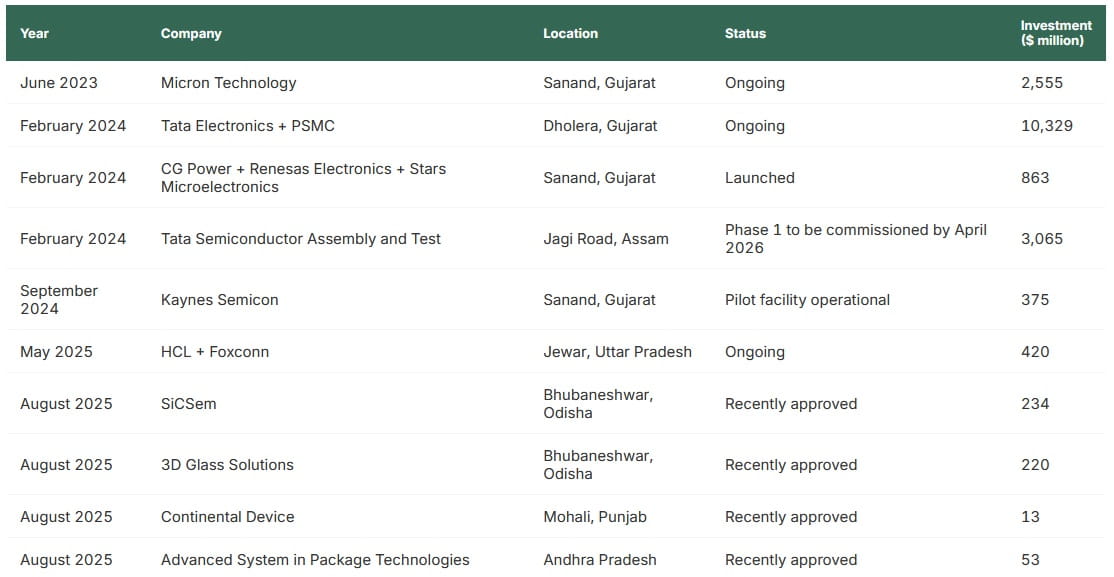
In December 2021, the Indian Semiconductor Mission (ISM) was established as the national authority under the Central Government’s Ministry of Electronics and Information Technology (MeitY) to evaluate and assess investments, as well as implement semiconductor initiatives within the country. The ISM has approved ten projects to strengthen India’s semiconductor ecosystem in under four years. These projects encompass a range of investments, from the substantial $11 billion (₹91,000 crores) fab investment announced by Tata Electronics Private Limited with the Partnership of Taiwan’s Powerchip Semiconductor Manufacturing Corporation (PSMC) to the cumulative investment of over $2.75 billion from Micron Technology in establishing an assembly, testing, marking, and packaging (ATMP) facility. Other significant projects include an outsourced semiconductor assembly and test (OSAT) plant in Assam, two manufacturing facilities in Sanand, Gujarat, and a semiconductor plant in Uttar Pradesh.
The government’s Semicon India programme, launched with a budget of ₹76,000 crore ($9.2 billion), aims to support not only fab manufacturing units but also the entire chip production ecosystem. From 2023 to 2025, a total of ten approved projects under ISM were reached, with cumulative investments of around ₹1.62 lakh crore ($19.3 billion) in six states.
More recent approvals were in Odisha, Andhra Pradesh, and Punjab, which have increased total investments to $18.3 billion. The programme offers production-linked incentives to encourage domestic production of electronic components and semiconductor manufacturing. Major names are already on board, with Tata Electronics in Gujarat and Assam; Foxconn and HCL Group in Jewar; CG Power-Renesas in Gujarat; and Micron’s assembly, test, manufacturing and packaging facility in Gujarat. Prime Minister Modi has [pledged](https://ddnews.gov.in/en/made-in-india-semiconductor-chips-will-be-in-markets-by-the-end-of-year-pm-modi/%252523:~:text=Prime%25252520Minister%25252520Narendra%25252520Modi,%25252520in,push%25252520for%25252520technological%25252520self-reliance.) that India-made chips will be commercially available by the end of 2025.
On 12 August 2025, the Union Cabinet, chaired by Prime Minister Modi, approved the establishment of our new semiconductor manufacturing facilities under the ISM. This marked a significant step towards strengthening India’s semiconductor ecosystem. The approved proposals from SiCSem, Continental Device India Private Limited (CDIL), 3D Glass Solutions Inc., and Advanced System in Package (ASIP) Technologies will attract a combined investment of around ₹4,600 crore and are expected to generate employment for more than 2,000 skilled professionals. With these approvals, the total number of sanctioned projects under ISM now stands at ten, spanning six states with cumulative investments of approximately ₹1.60 lakh crore. These new facilities, including India’s first commercial compound semiconductor fab by SiCSem and a cutting-edge glass substrate packaging unit by 3DGS, both in Odisha, are poised to play a critical role in advancing technologies for defence, EVs, telecom, AI, and consumer electronics, contributing significantly to the vision of an Atmanirbhar and Viksit Bharat (see Table 1).
Table 1. India’s Semiconductor Facilities
Indian States are Competing