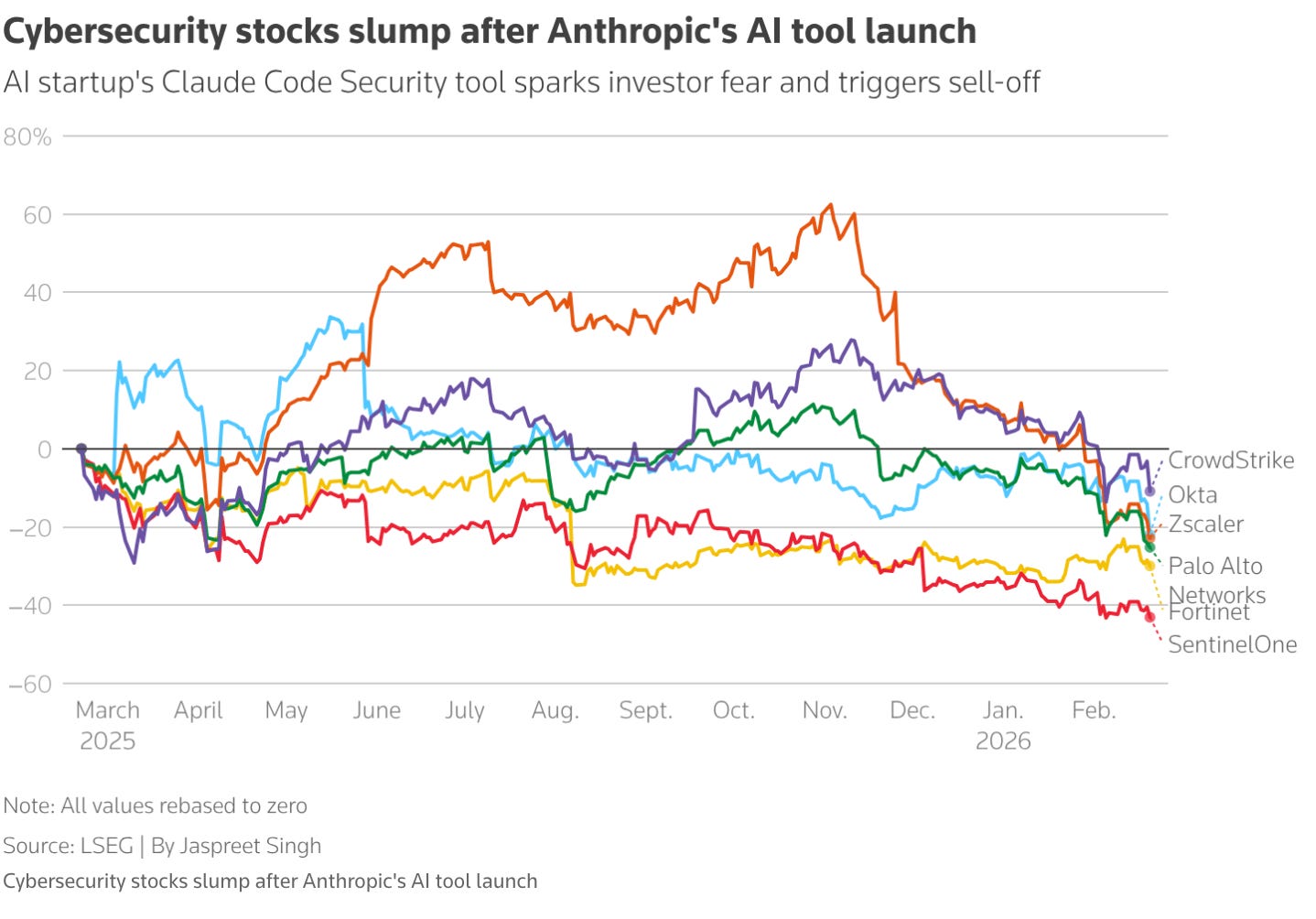
Last week, the market gave us a reminder of who owns the “high ground” in software.
After Anthropic announced a security-focused AI capability, several public cybersecurity names sold off (CrowdStrike, Datadog, Zscaler, etc.) — not because they missed earnings, but because investors instantly priced in a new reality: the model providers are moving into the application layer.1
(source)
And then, one day later, came the second signal — even more revealing: Anthropic softened its own safety commitments, explicitly pointing to competitive pressure. In plain English: “we can’t afford to be the only ones slowing down.”2
Loading...
Every founder has this thought at 2 a.m.:
“What if we build this thing… and then Google / Microsoft / Apple / OpenAI / Anthropic just ships it as a feature?”
It’s not paranoia. It’s a rational fear — and it has moved up-market. It’s no longer just early-stage teams asking this question. It’s later-stage category leaders, and even AI-native companies building on top of the same platforms that might later compete with them.
In the 90s it was the OS and the browser. In the 2000s it was search and marketplaces. In the 2010s it was mobile and app stores. Now it’s the AI assistant becoming a new “interface layer” — and when the interface layer shifts, entire software categories get repriced.
We’ve seen this movie before. The names change. The mechanics don’t.
Pic: A young founder, moments before discovering what ‘disruptive advantage’ means. (source)

So instead of hand-waving it away — or turning it into a moral debate — this post does the boring but useful thing: it breaks down how this actually plays out in the real world. When incumbents copy and kill. When copying backfires. When the startup pivots and wins. When the outcome is an acquisition instead of a war.
Same story every decade. New interface layer. Old powers. Fresh founders.
Subscribe
Before we get into mechanisms and outcomes, it helps to remember: this game has roles.
Pic: The platform stack as a social system — boss, crew, family, and a few people who make the rules. (source)