The Silverlands Fund’s business model is all about bringing industrial agriculture to Africa. (Credit: Oaklins)
Financial flows going into agriculture are growing more and more institutionalised – and more and more private. To be sure, investing in agriculture has been going on since time immemorial. After all, farmers do it every day as they improve their soils, set up cooperatives, share knowledge with their children and develop local markets. But since the mid 2000s, institutional investment in agriculture has started growing. From seven agriculture-focused funds in 2004 to more than 300 today, the interest in capturing profits from farming and agribusiness on a global scale is real – and Covid-19 is not slowing things down. Who is involved? Where is the money going? How do these funds pay off for the financial players and for local communities? These are some of the questions we set out to get answers to, in order to better understand capital flows and who is influencing the direction of agriculture today.
Before the global financial crisis erupted in 2008, there was just a handful of funds catering to investors wanting to get involved in farmland and food production. Valoral, an investment advisor in Argentina, counted seven such funds in 2004.1 GRAIN identified 55 a few years later.2 Today, according to Preqin, a London-based alternative investment intelligence group, there are more than 300.3
Most of these funds are “private equity” funds. That is, they are pools of money injected into private companies that are not listed on stock exchanges (and therefore not subject to public reporting requirements). Private equity funds are managed by small, specialised teams and tend to attract a very specific kind of clientele. As they normally require minimum investments in the millions of dollars, which then get locked up for five to 15 years, this kind of investing is only accessible to pension funds, sovereign wealth funds, endowment funds, family offices, governments, banks, insurance companies and high net worth individuals. This will be changing soon, as the US opens the door for private equity firms to tap into the retirement savings of individual workers, but for now it’s only these big institutions which are involved.4
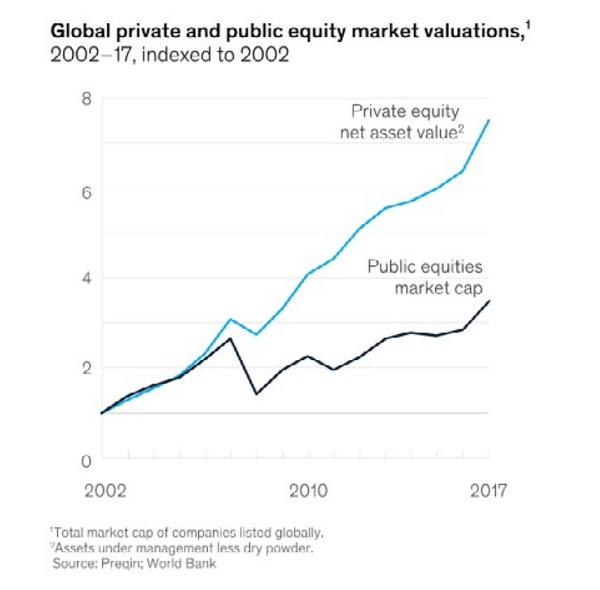
Private equity investing bloomed in the 1980s when “leveraged buyouts” and “venture capital” became well known strategies to take over companies and buy into startups. Investment houses like KKR, Carlyle Group and Bain Capital grew legendary on Wall Street and notorious on Main Street for their hyperbolic projects, cut throat methods and fantastic profits.
Today, the private equity industry has secured a solid spot on the investment landscape. In 2019, it ranked third among institutional investing spaces, with over US$4 trillion under management (see table 1). This is comparable to the US$4.5 trillion wielded by the world’s development banks, and far outstrips the US$1.5 trillion invested by US and European philanthropic foundations.5
Table 1: Institutional investing (assets under management, 2019)
| USD | |
|---|---|
| Pension funds | 40 trillion |
| Sovereign wealth funds | 8 trillion |
| Private equity funds | 4 trillion |
| Hedge funds | 3 trillion |
But the reality of private equity investing is not as glossy as Wall Street spin would make it out to be. GRAIN took a look into how it’s operating in the field of food and agriculture today and came out with some important findings.
The big picture
Information about private equity is not easy to come by, as private equity firms are not required to publish data about their operations.6 But we were able to access some specialised data to get a look at the industry’s footprint in food and agriculture. The data is incomplete, but it does give some clear indicators (see box: A word on the data).
A word on the data
In early 2020, GRAIN studied over 300 funds active in the area of food and agriculture. Our departure point was a list of funds focused specifically on “natural resources” according to Preqin, the industry leader in data on “alternative” investments (anything not stocks or bonds). "Natural resources" covers energy, timber land and farmland. From this group, we screened out those funds specifically investing in agriculture. We added to this a number of funds classified as broader “private equity” funds which appeared on our radar because of significant deals they made in the agriculture arena. But we did not screen the full set of generalist private equity funds as there are 3,500 of them. Nor did we comb through the nearly 4,000 buyout deals or the 3,700 venture capital deals tagged “food” or “agribusiness” by Preqin.
This means that we stayed close to the production process – farming, livestock production and fishing. It also means that our dataset is not comprehensive. It is, however, representative of private capital investing in agriculture, as our findings align with Preqin’s overall reporting.
While our main source of data was the Preqin Pro database, publications and staff, we also relied on AgriInvestor, Pensions & Investments, company websites and generalist news sources like the Financial Times.
Scale and scope of ag investing
Today, at least 300 private equity funds are specifically oriented towards food and agriculture.7 A subset of these, run by 200 fund managers, are focused on farmland per se (acquiring or operating farms). Other private equity funds, with diversified portfolios, also buy into food and agriculture, but usually on the downstream side (processing, distribution and service). Preqin’s assessment of farmland funds shows a rising number of closings over the years, peaking in 2013 and again in 2019 (see table 2), with a total aggregate capital raised of US$8.4 billion in 2019.
Table 2: Annual unlisted agriculture/farmland fundraising, 2008-2019