
The dominant paradigm in AI today, insofar as it is used in production-ready settings, is organized around language and code. The scaling laws governing large language models are well-characterized, the commercial flywheel of data, compute, and algorithmic improvement is spinning, and the returns to incremental capability gains remain large and mostly legible. This paradigm has earned the capital and attention it commands.
But a set of adjacent and related fields has been making meaningful strides in its gestation phase. These areas of activity include VLAs, WAMs, and other approaches to generalist robotics models, physical and scientific reasoning in the pursuit of AI scientists, and novel interfaces for human-computer interaction (including BCIs and neurotech) that take advantage of advances in AI to rethink how we interact with machines. Beyond technical progress, each of these areas has seen the beginnings of an influx in talent, capital, and founder activity. The technical primitives for extending frontier AI into the physical world are maturing concurrently, and the pace of progress over the past eighteen months suggests that these fields could soon enter a scaling regime of their own.
In a given technology paradigm, the areas with the greatest delta between their current perceived capabilities and medium-term upside potential tend to be those that benefit from the same scaling dynamics driving the current frontier, but sit one step removed from the incumbent paradigm — close enough to inherit its infrastructure and research momentum, but distant enough to require non-trivial additional work. This distance serves a dual function: it creates a natural moat against fast-following, and it defines a problem space that is richer, less explored, and more likely to produce emergent capabilities precisely because the easy paths have not already been taken.
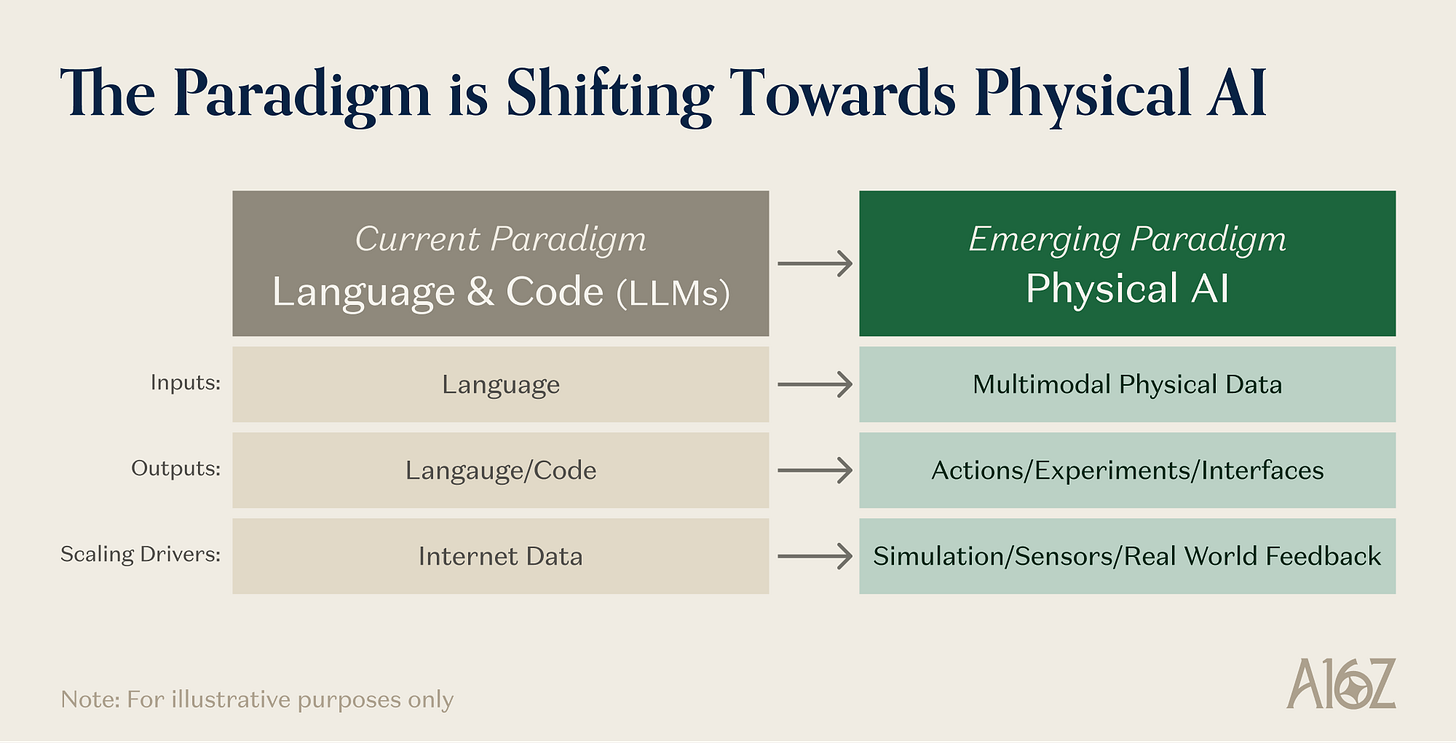
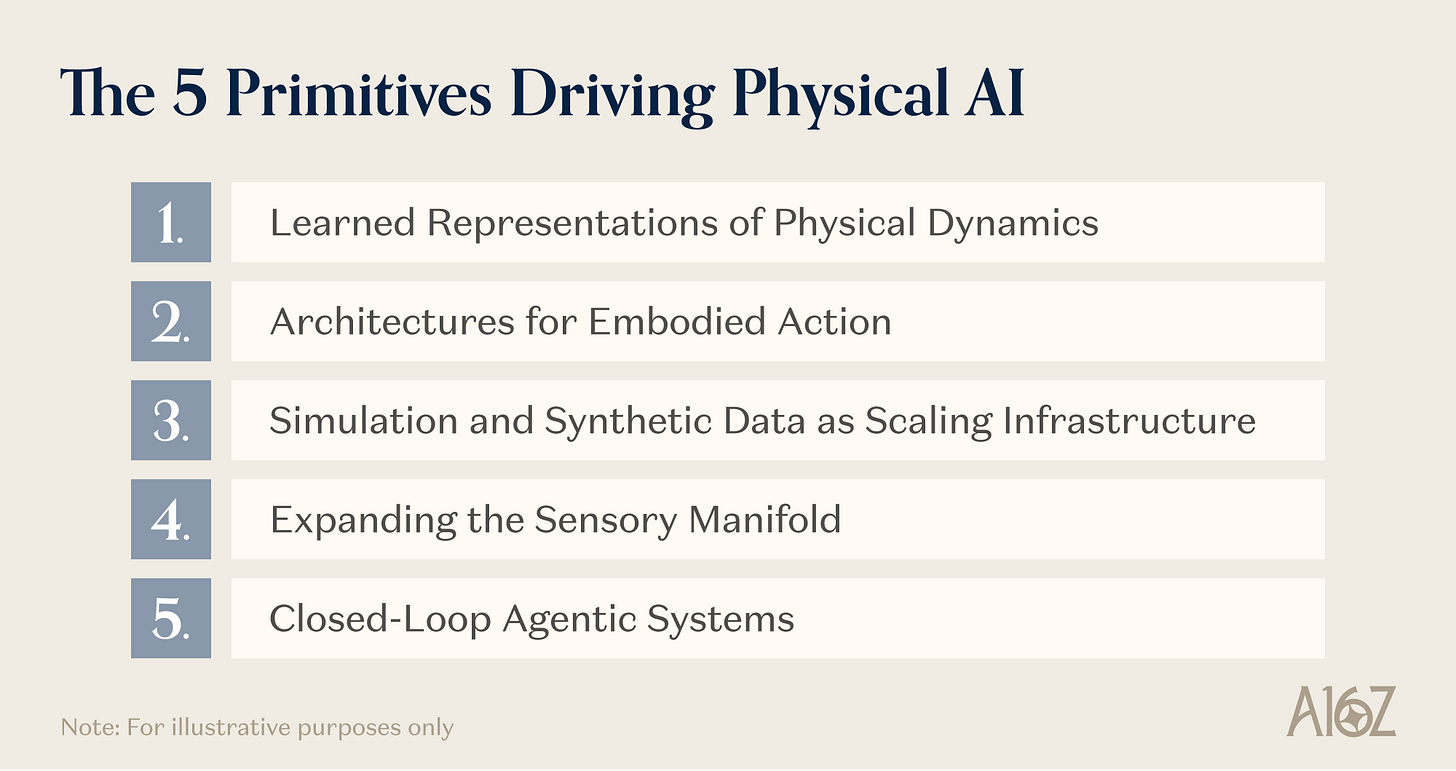
Three domains fit this description today: robot learning, autonomous science (particularly in materials and life sciences), and new human-machine interfaces (including brain-computer interfaces, silent speech, neural wearables, and novel sensory modalities like digitized olfaction). These are not entirely separate efforts, and thematically are part of a group of emerging frontier systems for the physical world. They share a common substrate of technical primitives, like learned representations of physical dynamics, architectures for embodied action, simulation and synthetic data infrastructure, an expanding sensory manifold, and closed-loop agentic orchestration. They are mutually reinforcing in ways that create compounding dynamics across domains. And they are the areas where qualitatively new AI capabilities are most likely to emerge from the interaction of model scale, physical grounding, and novel data modalities.
This essay surveys the technical primitives underlying these systems, examines why these three domains specifically represent frontier opportunities, and proposes that their mutual reinforcement constitutes a structural flywheel for extending AI into the physical world.
Before examining specific application domains, it’s worth understanding the shared technical foundations that make these frontier systems possible. Five main primitives underpin the advance of frontier AI into the physical world. These technologies aren’t necessarily specific to any particular application area; rather, they are the building blocks that enable the creation of systems that extend AI to the physical world. Their concurrent maturation is what makes the emerging moment distinctive.
The most fundamental primitive is the ability to learn compressed, general-purpose representations of how the physical world behaves — how objects move, deform, collide, and respond to force. Without this, every physical world AI system must learn the physics of its domain from scratch, a prohibitively expensive proposition.
Multiple architectural families are converging on this capability from different directions. Vision-Language-Action models (VLAs) approach it from above: they take pretrained vision-language models—already rich with semantic understanding of objects, spatial relations, and language—and extend them with action decoders that output motor commands. The key insight is that the enormous cost of learning to see and understand the world can be amortized across internet-scale image-text pretraining. Models like π₀ from Physical Intelligence, Google DeepMind’s Gemini Robotics, or NVIDIA’s GR00T N1 have demonstrated this architecture at increasing scale.
World Action Models (WAMs) approach the same capability from below: they build on video diffusion transformers pretrained on internet-scale video, inheriting rich priors about physical dynamics—how objects fall, occlude, and interact under force—and coupling these priors with action generation. NVIDIA’s DreamZero demonstrates zero-shot generalization to entirely new tasks and environments, achieving a meaningful improvement in real-world generalization while enabling cross-embodiment transfer from human video demonstrations with only small amounts of adaptation data.
A third path, and one that may be the most instructive for understanding where this field is heading, dispenses with both pretrained VLMs and video diffusion backbones entirely. Generalist’s GEN-1 is a native embodied foundation model trained from scratch on over half a million hours of real-world physical interaction data, collected primarily through low-cost wearable devices on humans performing everyday manipulation tasks. It is not a VLA in the standard sense (as there is no vision-language backbone being fine-tuned), nor is it a WAM. It is instead a first-class foundation model for physical interaction, designed from the ground up to learn representations of dynamics from the statistics of human-object contact rather than from internet images, text, or video.
Spatial intelligence, like that being built by companies like World Labs, is valuable for this primitive because it addresses a representation gap that VLAs, WAMs, and native embodied models all share: none of them explicitly model the three-dimensional structure of the scenes they operate in. VLAs inherit 2D visual features from image-text pretraining. WAMs learn dynamics from video, which is a 2D projection of 3D reality. Models that learn from wearable sensor data capture forces and kinematics, but not scene geometry. Spatial intelligence models can help fill this gap by learning to reconstruct, generate, and reason about the full 3D structure of physical environments — geometry, lighting, occlusion, object relationships, and spatial layout.
Convergence between approaches here is the point. Whether the representations are inherited from VLMs, learned through video co-training, or built natively from physical interaction data, the underlying primitive is the same: compressed, transferable models of how the physical world behaves. The data flywheel for these representations is enormous and largely untapped — encompassing not just internet video and robot trajectories, but the vast corpus of human physical experience that wearable devices are now beginning to capture at scale. The same representations serve a robot learning to fold towels, a self-driving laboratory predicting reaction outcomes, and a neural decoder interpreting the motor cortex’s plan for grasping.
Representations of physics are necessary but insufficient. Translating understanding into reliable physical action requires architectures that solve several interrelated problems: mapping high-level intent to continuous motor commands, maintaining coherence over long action horizons, operating within real-time latency constraints, and improving with experience.
The dual-system hierarchical architecture — separating a slow, powerful vision-language model for scene understanding and task reasoning (System 2) from a fast, lightweight visuomotor policy for real-time control (System 1)—has converged as the standard design pattern for complex embodiments. GR00T N1, Gemini Robotics, and Figure’s Helix all adopt variants of this approach, resolving the fundamental tension between the rich reasoning that large models provide and the millisecond-scale control frequencies that physical tasks demand. Alternatively, Generalist takes an approach of harmonic reasoning for simultaneous thinking and action.
The action generation mechanism itself is evolving rapidly. Flow matching and diffusion-based action heads, pioneered by π₀, have emerged as the dominant approach for producing smooth, high-frequency continuous actions, displacing the discrete tokenization methods borrowed from language modeling. These methods treat action generation as a denoising process analogous to image synthesis, yielding trajectories that are physically smoother and more robust to compounding errors than autoregressive token prediction.
But the most consequential architectural development may be the extension of reinforcement learning to pretrained VLAs — the idea that a foundation model trained on demonstrations can then improve through its own autonomous practice, much as a person refines a skill through repetition and self-correction. Physical Intelligence’s work on π*₀.₆ represents the clearest demonstration of this principle at scale. Their method, RECAP (RL with Experience and Corrections via Advantage-conditioned Policies), addresses a problem that pure imitation learning cannot solve: credit assignment over long task horizons. If a robot grasps an espresso machine’s portafilter at a slightly wrong angle, the failure may not manifest until several steps later when insertion fails. Imitation learning has no mechanism to attribute the failure to the earlier grasp; RL does. RECAP trains a value function that estimates the probability of success from any intermediate state, then conditions the VLA to select high-advantage actions. Critically, it incorporates heterogeneous data (demonstrations, on-policy autonomous experience, expert teleoperated corrections provided during execution, etc.) into a unified training pipeline.
The results of this approach are encouraging for the future of RL for actions. π*₀.₆ folds laundry across 50 novel garment types in real homes, reliably assembles boxes, and prepares espresso drinks on a professional machine, running continuously for hours without human intervention. On the most difficult tasks, RECAP more than doubles throughput and cuts failure rates by half or more compared to the imitation-only baseline. The system also demonstrates that RL post-training yields qualitatively different behaviors from imitation, like smoother recoveries, more efficient grasp strategies, and adaptive error correction that were not present in the demonstration data.