
[Disclosure: AgFunderNews’ parent company is AgFunder.]
“Self-sufficiency” and “resiliency” are top of mind for Europe’s food and agriculture industries right now thanks to US President Trump’s growing trade war and anti-European comments, combined with climate change impacts like the 2024 floods and heatwaves.
Just this week, the European Commission told the public to stockpile at least 72 hours’ worth of “critical supplies” to prepare for “risks including natural disasters, cyber attacks and geopolitical crises, including the possibility of armed aggression against EU countries.”
It follows, then, that those investing in European agrifoodtech startups will be evaluating prospective startups with a resiliency lens at hand when deploying capital.
And yes, there is a bit of capital to deploy, despite the global decline in agrifoodtech funding as outlined in AgFunder’s latest Global AgriFoodTech Investment Report.
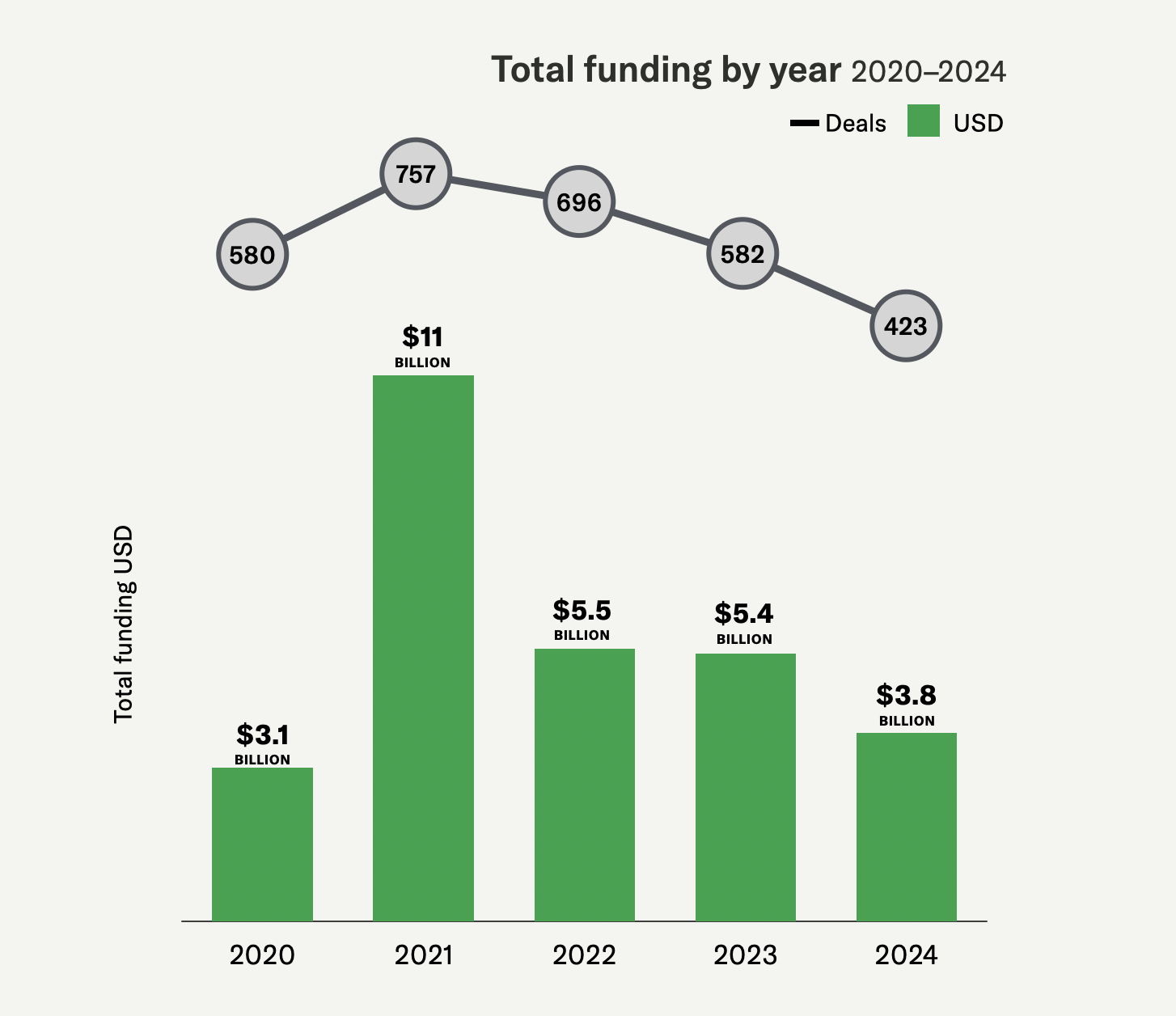
In Europe, agrifoodtech funding dropped 29% in 2024, from $5.4 billion in 2023 to $3.8 billion; deal count fell 27% over the same time, from 582 to 423, respectively. This is against the backdrop of a far more modest decline—4%—in global agrifoodtech funding over the same period.
While still nowhere close to the $11 billion raised in outlier year 2021, European funding is nonetheless ahead of where it was in 2020 ($3.1 billion) and 2019 ($3.5 billion), reverting to that pre-Covid and pre-crazy valuation time some commentators refer to as the mean.
Europe agrifoodtech investment over time. Source: AgFunder AgriFoodTech Investment Report 2025
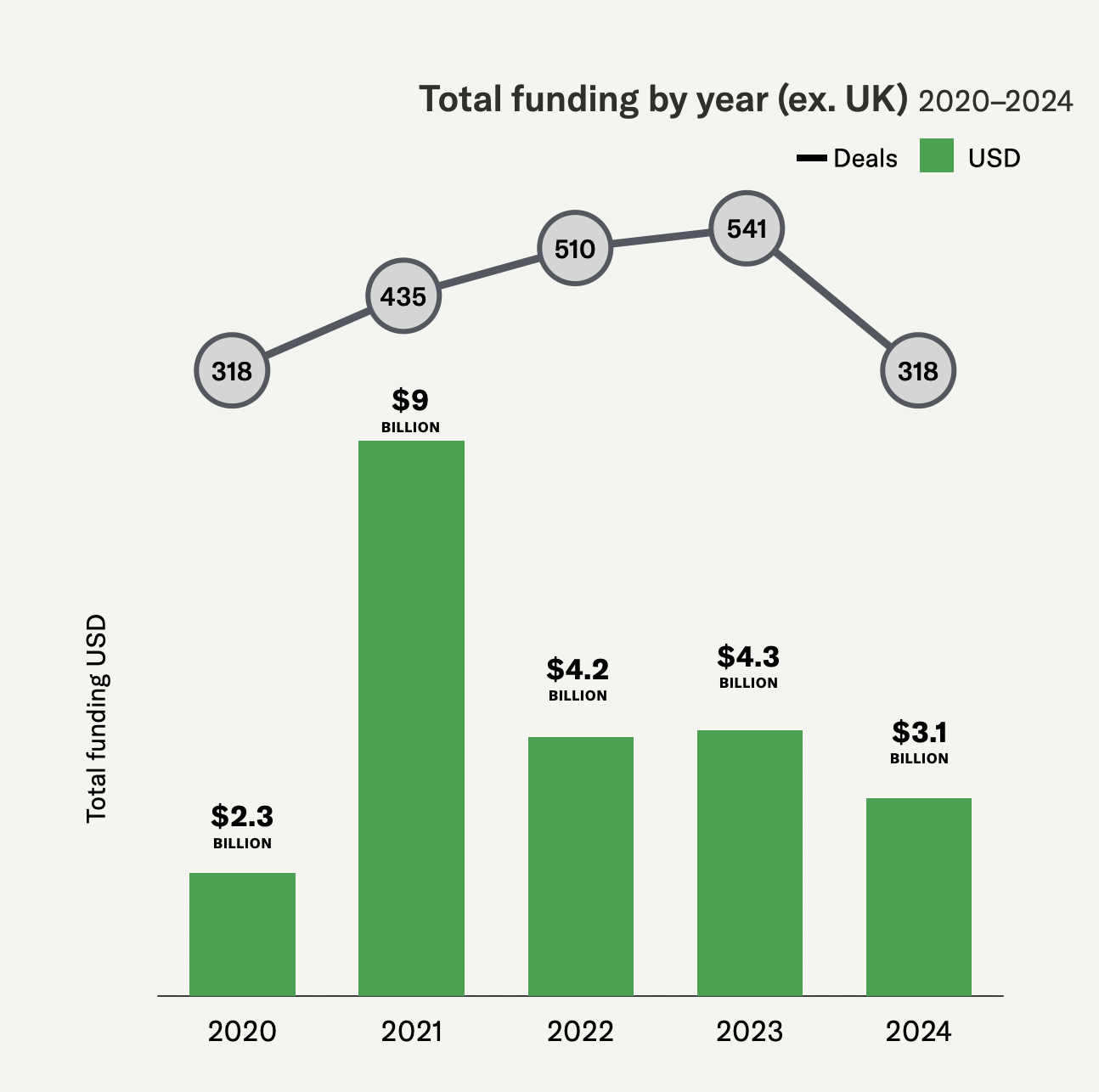
Removing the UK—which raised just under $650 million—in 2024, from the data, the total figure is just over $3.1 billion.
Funding over time hovers near the $1 billion mark, excepting 2021 when the difference is $2 billion. A decline in deal count is more pronounced from 2023 to 2024 once the UK is removed from the data:
Europe agrifoodtech investment over time excluding UK. Source: AgFunder AgriFoodTech Investment Report 2025
Some even believe a recovery is in the works in 2025. “Things can only go in one direction: up,” says Sweden Foodtech founder Johan Jörgensen. Likewise, some 50% of venture capitalists we surveyed believe the recovery has started.
Jörgensen likens the last few years to a “tidying up” of sorts after the excess years of cheap money and inflated valuations.
“We seem to be pretty done with that, and we can start to look forward again to putting capital towards new investments instead of just saving what we have,” he says.
However, Max Brandes, investment manager, venture capital at Germany’s Rentenbank, says that he doesn’t see “a significant change” in the funding situation over the next 12 months and that there may be further drops in valuations.
That said, Brandes also notes that, “there’s quite a lot of dry power, and this somehow needs to be allocated over the next years, and this can probably have a positive effect also in the funding situation of startups.” (Dry powder refers to uninvested fund capital awaiting deployment.)
“The trillion euros are there,” adds Jörgensen, referring to the money earmarked for the European Green Deal, which includes the food system. “The only question is, how it’s going to be deployed, when and where?”