Synthetic fertilizers play a pivotal role in global food production, with nitrogen-based fertilizers alone supporting the nutrition of around half the world’s population.
However, they come with significant environmental costs, as well as food security concerns. These extend to both the downstream application of the fertilizers on farms, as well as their upstream production and distribution. In this blog post, we’re focusing on the latter problem.
Nitrogen is a key crop nutrient, facilitating crucial processes like foliage growth, amino acid synthesis, and chlorophyll development. In nature, plants absorb nitrogen from the soil, where it is fixed from the air in various bioavailable forms by microbes.
During the 19th century, scientists and engineers raced to find ways to synthesize nitrogen to boost crop cultivation beyond what these naturally occurring microbes made possible. The result of those endeavors is the Haber-Bosch process, which enables the large-scale industrial production of ammonia; a nitrogen-containing compound that is the precursor to most nitrogen fertilizers used today.
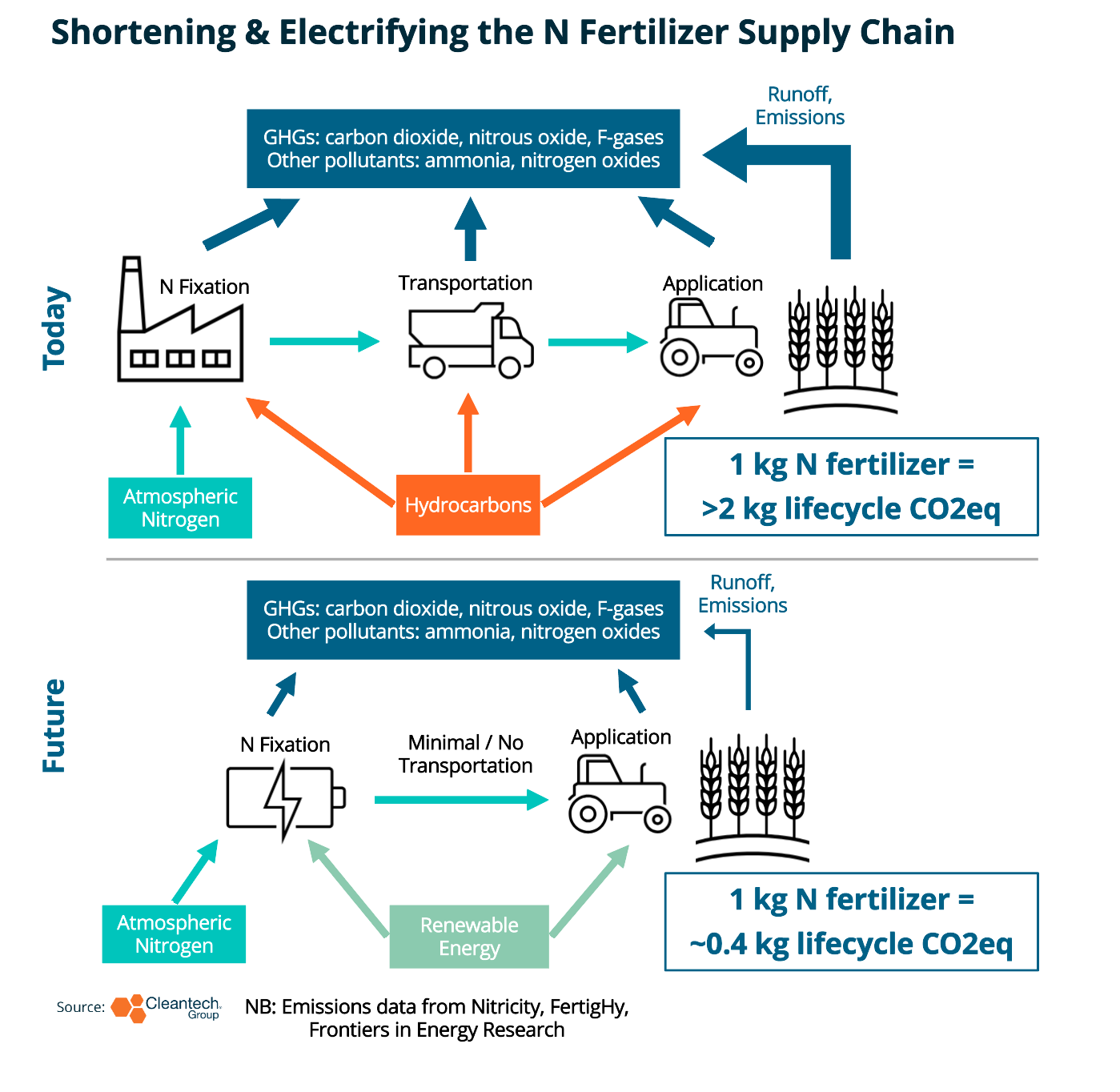
The conventional Haber-Bosch process works by reacting nitrogen from the air with hydrogen sourced from fossil fuels, typically natural gas. Fossil fuels are also required to create the high temperatures needed for this reaction to take place. The energy-intensive nature of traditional fertilizer production accounts for somewhere in the region of 1-2% of total global energy use and 1-2% of total global greenhouse gas emissions.
Moreover, to achieve the economies-of-scale needed for mass production, the industry is highly centralized. As a result, long-distance transportation is required to get fertilizer to its end users (i.e., farms). This stacks further emissions as well as leaves fertilizers deeply sensitive to supply chain shocks. For example, fertilizer prices skyrocketed between 2020-2022 due to Covid-related disruptions, small inventories, the escalation of the Russo-Ukraine conflict, and an effective export ban imposed by major Chinese producers and distributors.
Nevertheless, demand for fertilizer continues to rise, primarily from lower-income countries which are most in need of nutrients to boost yields and are typically located furthest from the points of production.
A recognition of the need to mitigate these energy consumption issues, emissions, and supply chain inefficiencies has spurred innovation around distributed fertilizer production models. Such models aim to minimize transportation needs and enhance sustainability by moving fertilizer production closer to end users while leveraging ‘cleaner’ approaches to nitrogen fixation.
In broad terms, two categories have emerged:
Despite the promising prospects of distributed production, challenges persist. Incumbent fertilizer companies have tended to focus on integrating carbon capture and storage technologies at traditional Haber-Bosch facilities (i.e., ‘blue ammonia’) and downstream interventions such as nitrogen-boosting biological inputs. With a few exceptions, they have only minimally engaged with mid-scale and micro-scale distributed technologies.
Instead, players from the food and energy industries are driving corporate involvement into distributed solutions. Examples include Nitricity’s field trial of its on-site nitrogen fixation technology with Olam Food Ingredients, and Heineken and RIC Energy becoming founding investors in FertigHy.