
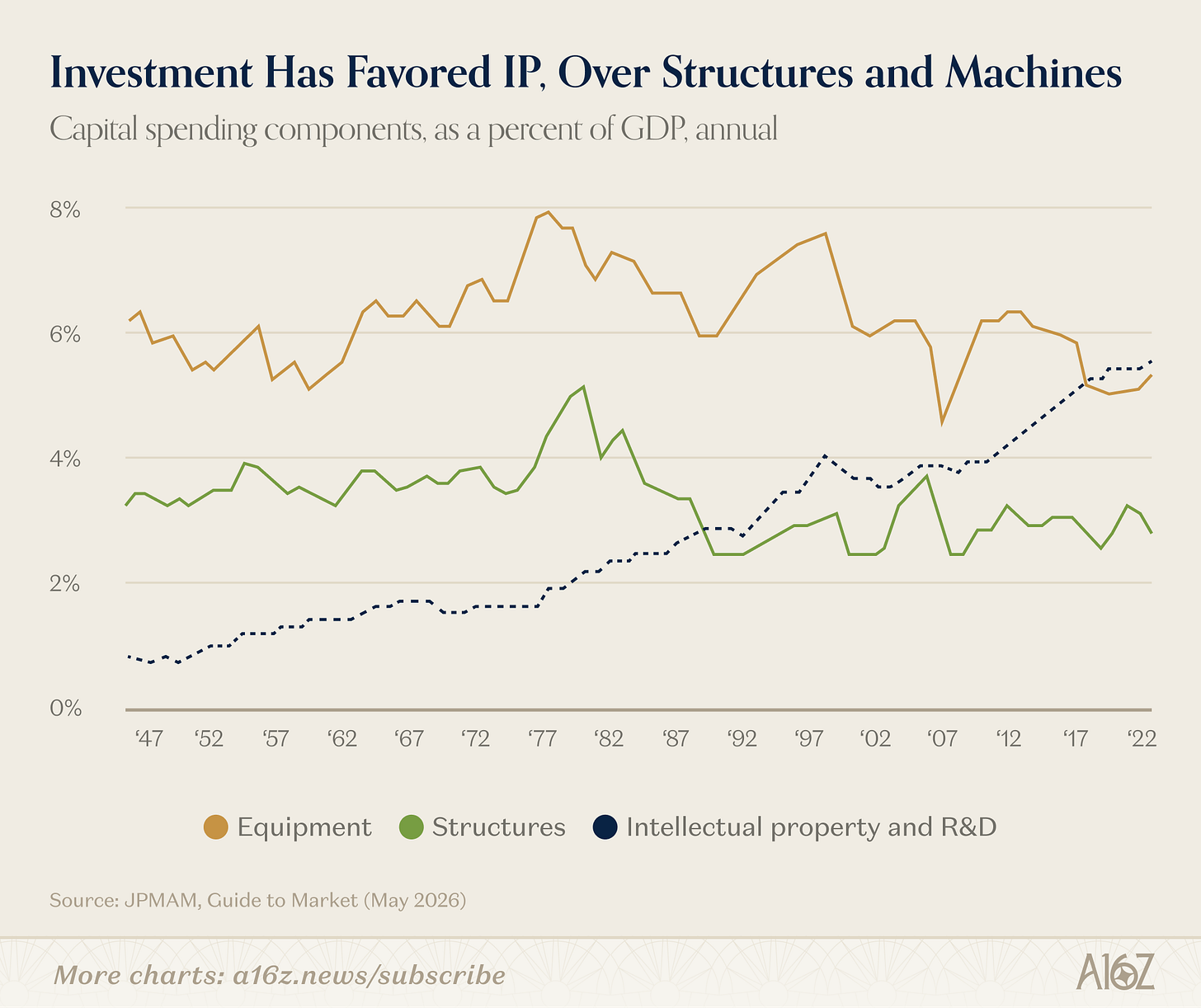
Indeed, even within the category of “equipment” (which has experienced an investment boost in the last few years, with growth approaching 9%), the manufacturing boom-let is fairly narrow, with a singular focus on AI. Investment in core industrial machinery is a smaller part of the picture, and that too, is largely dominated by AI-related needs:
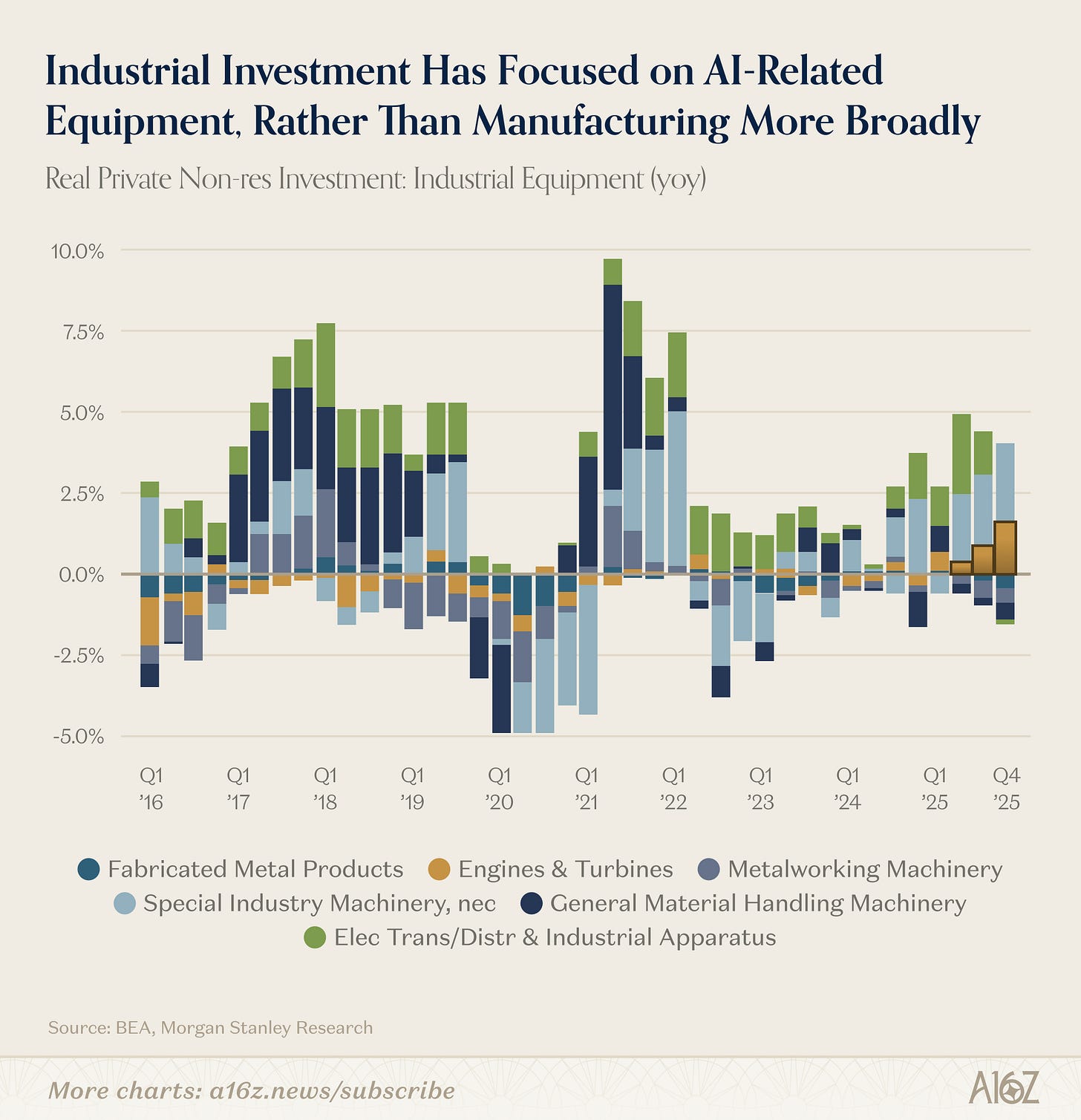
Investment in core industrial equipment (i.e. ex-AI) is about 50% turbines, HVAC, and the like, while the other half is “special industry machinery,” which, in this case, is likely at least part semiconductors, etc.
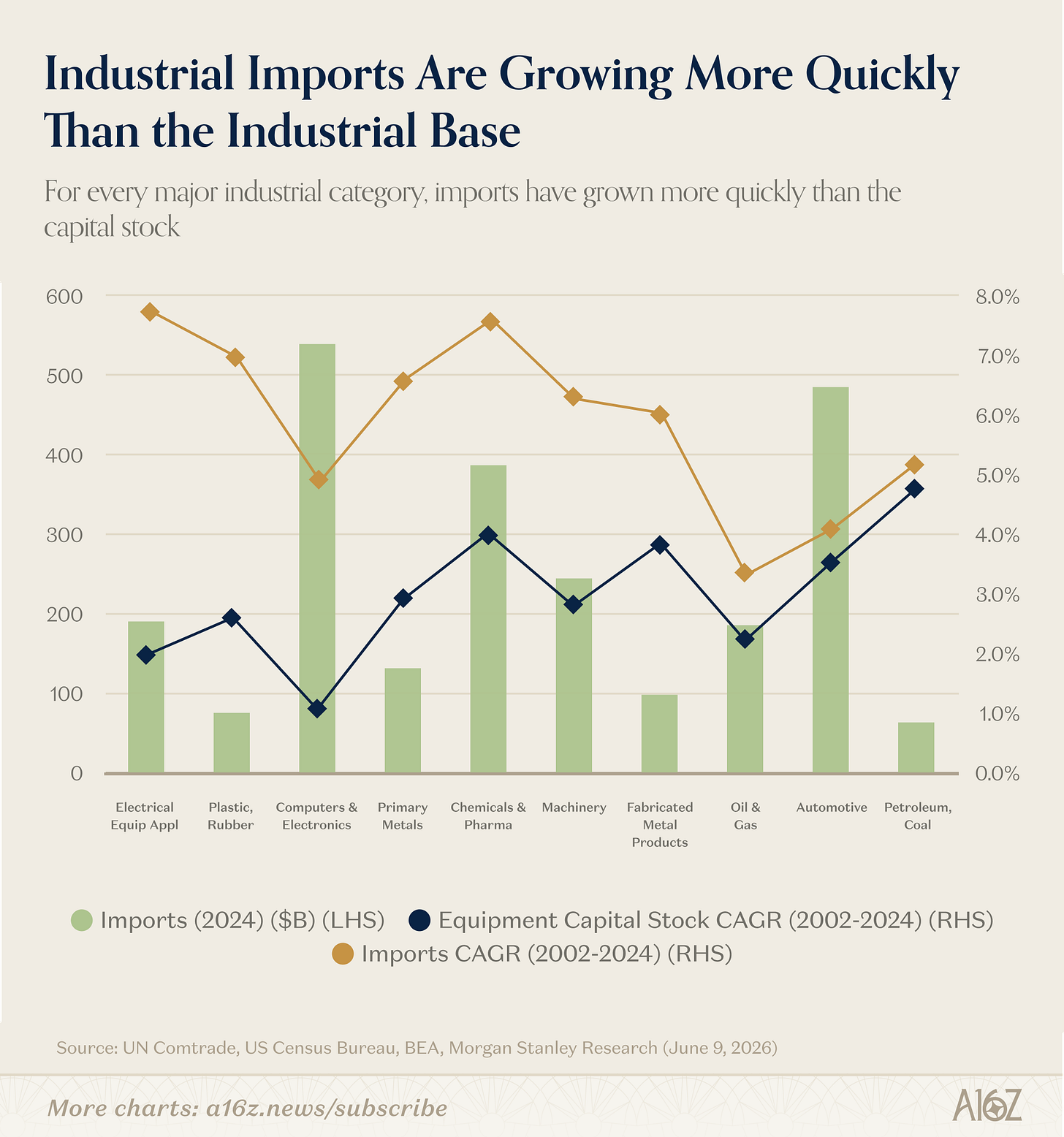
In other words, where there’s investment in the capital stock, it’s almost entirely focused on the AI build-out, rather than the manufacturing base, more broadly. That’s consistent with the imports story, as well, such that the surge in industrial investment is more aligned with existing supply chains, and less-so with configuring new, domestic ones.
The other thing that’s visible from these longer series is that, as per above, while capital spending on equipment has ticked up of late (as a share of GDP), the opposite is true when it comes to structures—and, once again, it’s hard to make more equipment (and truly “reindustrialize”) without the structures to make it in. For a more enduring transition, we need to increase capacity, and that tends to start with structures.
There too, while there have been some modest gains, the gains are, in fact, modest, and focused very much on AI. The CHIPS Act, lower interest rates, and AI likely combined to encourage a surge in semis-related industrial construction, but that has cooled off considerably since its peak in 2023. When it comes to core manufacturing capacity, especially of the sort that would be consistent with a broader non-AI expansion, investment has been a relative drop in the pail:
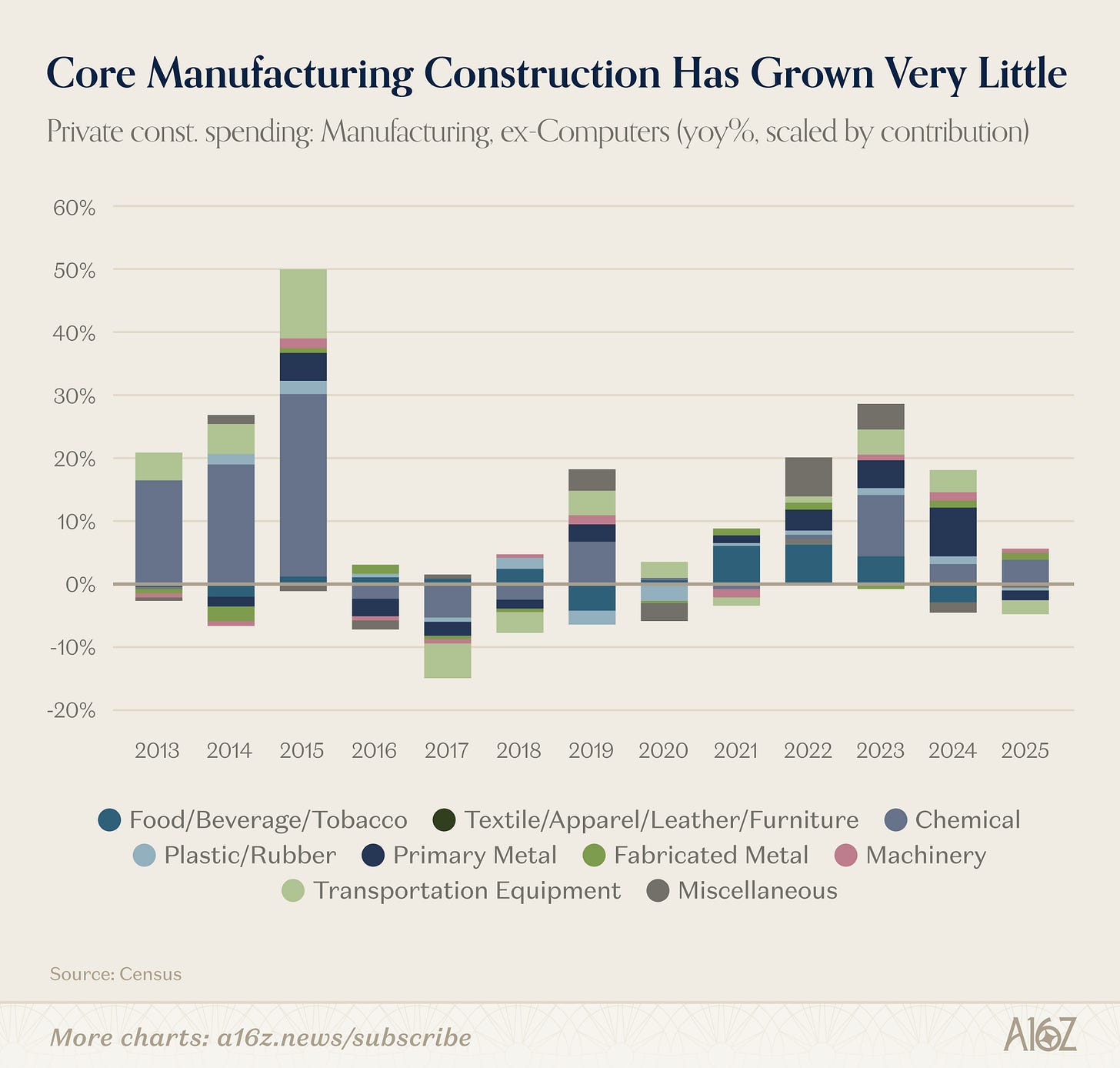
Outside of semis, manufacturing construction growth increased only ~3% in 2025, and the bulk of it was related to chemicals, consistent with a longer-running trend, as opposed to some recent impulse to domestic capacity.
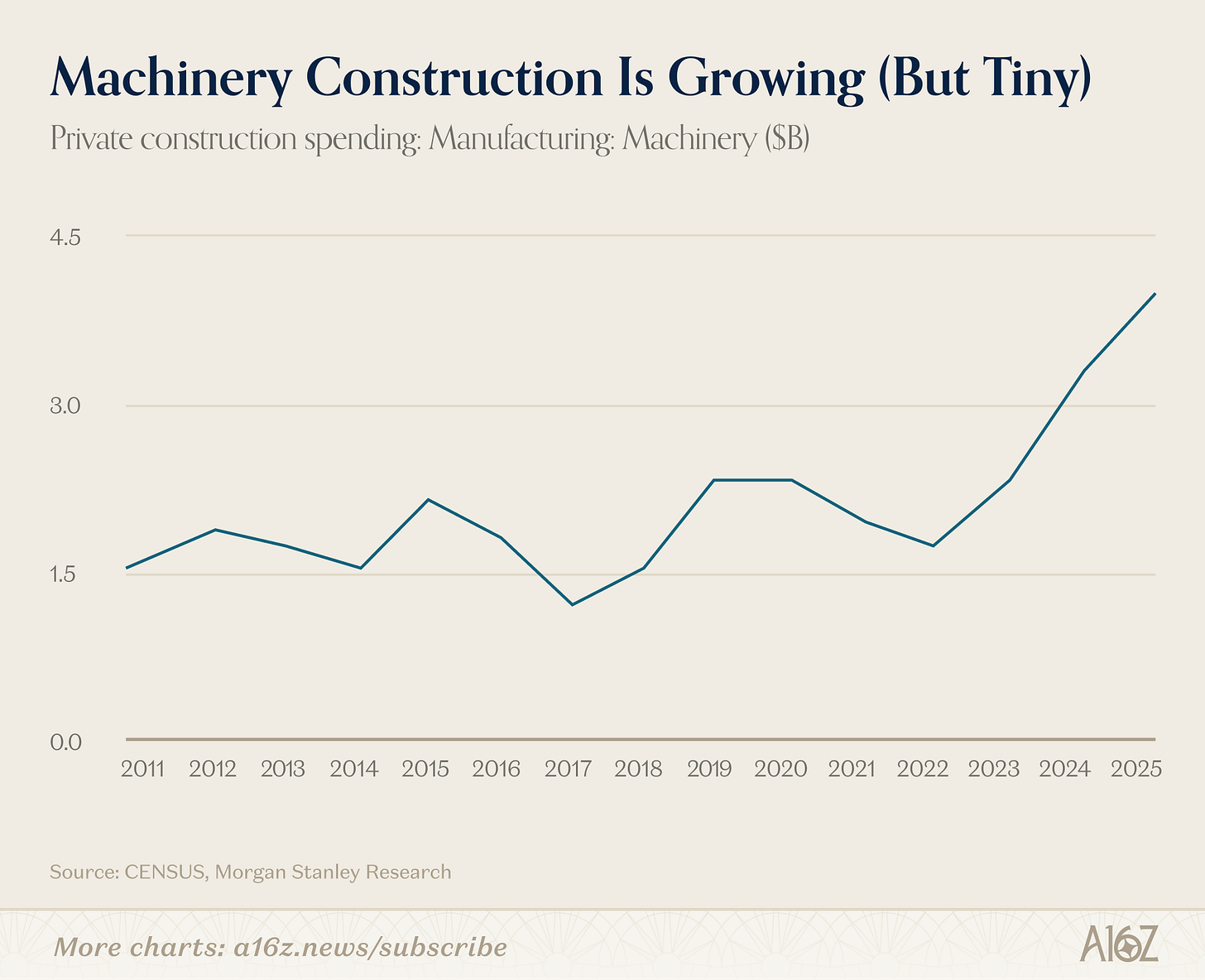
When it comes to machinery specifically, arguably the most important category to a broader industrial revival, construction spending has more than doubled since 2022 . . . from a paltry $1.5B to a slightly less paltry $3.9B.
Obviously, we don’t necessarily need more machine-making buildings to get more machines (or more machines to get more output)—we can also get more productive with the ones we’ve got—but there are limits.
In fact, there was a brief moment in this century when the US was a net exporter of machines, but since ~2013, the situation has reversed:
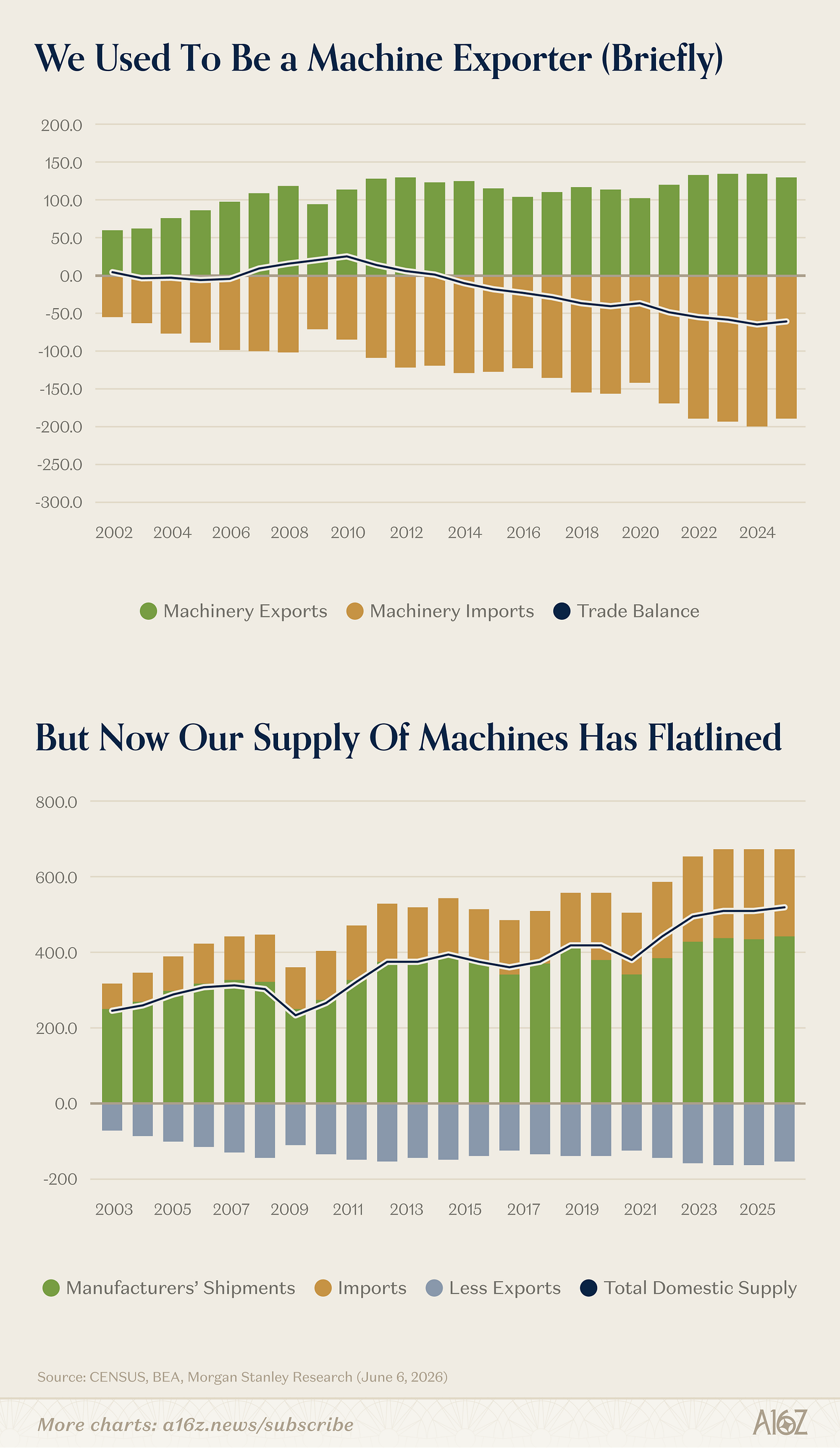
The domestic supply of machinery has increased over the years, but growth more or less tapered-off back in 2021.
The point here is fairly straightforward: if you think rebuilding the domestic manufacturing base is a good thing, then while there’s been some progress, there’s also a long way to go. For better or for worse, we simply have not been investing in the capital stock to support a broader industrial turn. We’re buying parts (especially AI-related parts), but if we’re going to be making more parts, then we need the buildings and machines to make the machines that make the parts, and there isn’t a whole lot of evidence that that transition is underway.
There’s plenty of anecdata that says “no one drinks anymore,” (especially, young folks). Last year, when the OKC Thunder won the championship, they left buckets of unopened beer and champagne, in a teetotaling display that would shock any athlete (or fan), especially from the ‘80s and ‘90s, when the good times most definitely rolled.
Putting anecdata aside, there’s some actual data, as well, to support the sober turn. There is some nuance, however.