
biology native data infrastructure
Drug development has long been a process of trial-and-error to test biological hypotheses against clinical reality. Despite advancements in science and technology, the timeline from target ID to a clinical candidate still often takes more than five years, and nearly 90% of drugs that enter clinical trials fail. With treatment landscapes evolving and modalities becoming increasingly complex, it is no surprise that R&D costs per approved therapy continue to double every nine years. The limiting factor in drug development has never been a shortage of hypotheses, but rather a shortage of the resources to evaluate them effectively and efficiently.
Machine learning in drug design holds the promise to change that math by accelerating iteration and improving the odds of success. Between 2012 and 2022, approximately 200 companies that leveraged AI for drug discovery raised a collective $18B. We are now seeing the results of these efforts play out in the clinic.
In June 2025, Insilico Medicine published positive Phase IIa results in Nature Medicine for its first-in-class small molecule TNIK inhibitor rentosertib in idiopathic pulmonary fibrosis. This made it the first drug to generate clinical proof-of-concept for which both the target was discovered and the molecule was designed entirely using generative AI. In this example, AI played a critical role in changing “the math” by leveraging a generative chemistry platform for molecule design and optimization. The team nominated a preclinical candidate after screening only 78 molecules, rather than the thousands typically required, and did so in 18 months at less than 10% of the average cost per approved drug.
With a favorable investment-reward profile, it is no surprise that many companies, including large pharma, have made concerted efforts to incorporate AI platforms into the R&D process to accelerate drug discovery. In early 2026, GSK and Eli Lilly announced deals with NOETIK and Chai Discovery for access to their oncology and drug design foundation models, with GSK committing $50M upfront to NOETIK and Lilly paying a mid-eight-figure annual access fee to Chai for biologics design.
Isomorphic Labs, the Google DeepMind spinout behind AlphaFold, has pursued deep partnerships with Lilly, Novartis, and J&J with potential value exceeding $3B, while advancing its own internal oncology pipeline toward first-in-human trials. Its newly released IsoDDE model more than doubles AlphaFold 3's accuracy on the hardest generalization benchmarks, making it one of the most closely watched companies in AI-driven drug design. And it's not just pharma showing interest: in early April 2026, Anthropic acquired Coefficient Bio, an eight-month-old startup built by former Evozyne/Genentech/Prescient Design computational biologists, for $400M in stock, signaling that frontier AI labs are now making direct bets on drug discovery.
Though computational chemistry tools first emerged in the 1980s, the modern era of AI for biotech effectively began with the rise of deep learning in the 2010s, when it became clear that neural networks could learn meaningful representations of molecular structure from data. The watershed moment occurred when DeepMind's AlphaFold2 and the Baker Lab's RoseTTAFold solved the problem of predicting a protein’s 3D structure from its amino acid sequence alone. From there, the number of biological AI models grew exponentially. By 2024, over 350 biological AI models were published, including AlphaFold3, ESM3, Boltz-1, BindCraft, Evo, scGPT, and H-Optimus-0, highlighting AI’s ability to perform tasks across generative protein design, genomics and perturbation modeling, and pathology image analysis.
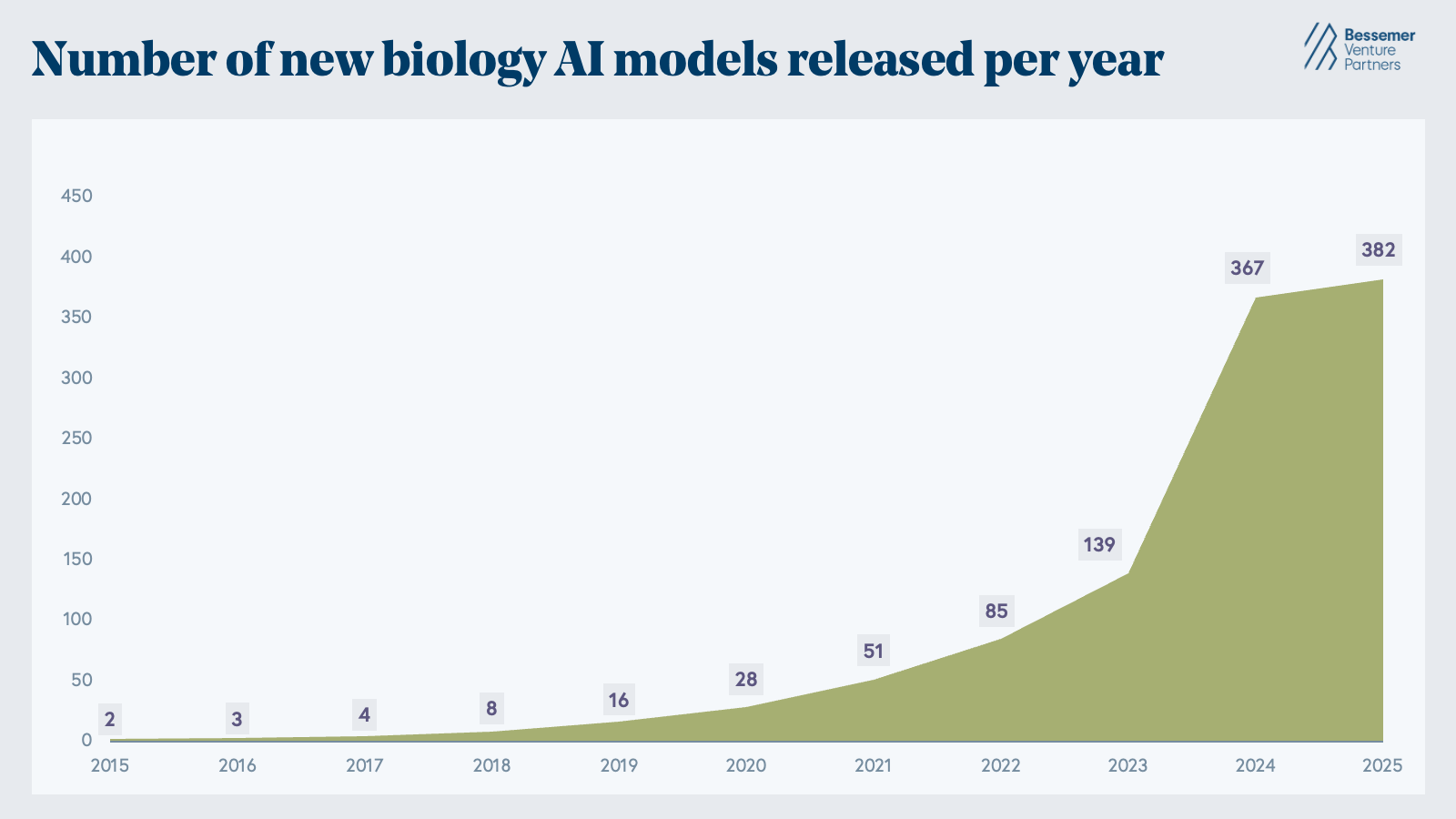
number of new biology AI models by year
The Cambrian explosion of AI models for biology has already happened. Between 2015 and 2025, the number of new biology AI models released each year has exponentially increased from sub-ten to 380+ and counting. (Note that this is based purely on the dataset from Epoch AI and may not be complete.)
Most recently, new models such as JAM-2, BoltzGen, Latent-X2, Chai-2, and IsoDDE have continued to bring us closer to designing drug-like biologics straight from the computer. Momentum on the zero-shot design task has never been stronger. Following a surge in new AI models for biology, the field now has an armamentarium of tools spanning the drug development continuum, from structural modeling to molecule design and drug optimization.
In an increasingly crowded landscape, we believe the AI-driven biotechs that persist and scale over time will be those built on three core principles, which together we define as the principles of biology-native data infrastructure:
Companies that enable or embody these principles will be the ones to truly accelerate drug design timelines, reduce clinical trial failure risk, and deliver on the promise that AI in biology holds.
Below we explain why these principles are critical to the drug development industry and highlight the emerging categories and companies that are putting these principles into practice.