Posted May 28th, 2025 in Biotech financing, Capital markets, General Venture Capital, R&D Productivity
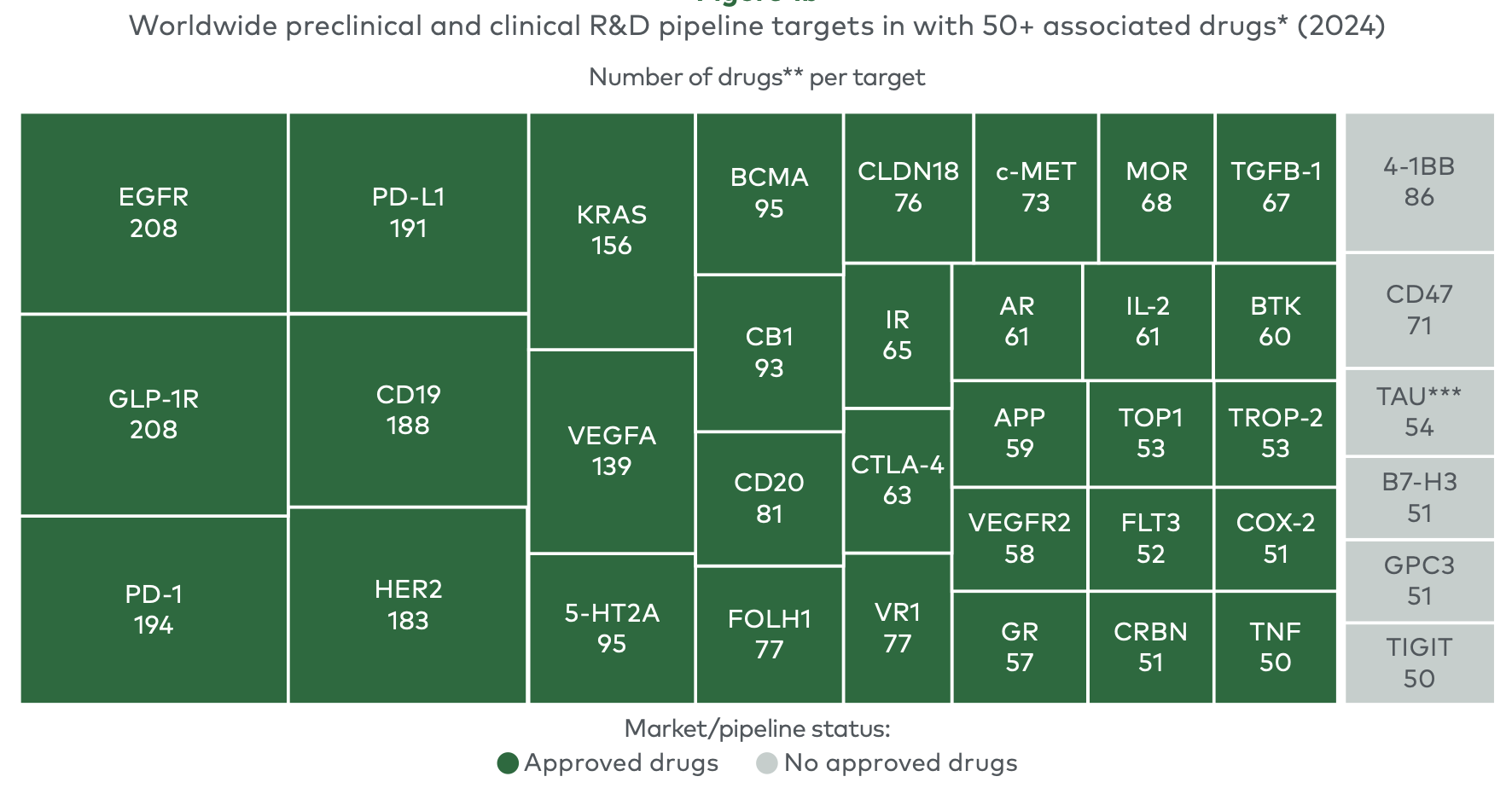
Over 200 GLP1 obesity programs are in development today. More than 300 PD1/PDL1 cancer programs exist. Greater than 150 programs target each of CD19 and KRAS. Therapeutic crowding has ratcheted up the competitive intensity in biotech to new levels.
While a perennial concern for decades in the biopharma industry around “hot” mechanisms of action (e.g., statins and SSRIs in the 1990s, TNFs in the 2000s, PD1’s in the 2010s, GLPs today), this herding into well-established mechanisms has accelerated in recent years – both in the volume of activity and in the pace of competition.
Here on this blog we’ve covered these topics a number of times in the past, with the “March of the Lemmings” in cancer in 2012 and “I/O: The Strategic Supernova In Cancer Today” in 2016.
But with the rise of China’s innovative sector, the proliferation of biologic drugs coded by DNA, and more than dozen years of abundant capital, to name just a few things – the challenge has only gotten worse.
As illustrated in LEK’s May 2025 report “Is Biopharma Doing Enough to Advance Novel Targets?” the scale of the current crowding challenge is staggering. All of these targets have at least 50 programs against them in preclinical or clinical development.
Further, the pace of “fast follower” drugs is striking relative the past: according to PhRMA’s recent report on innovation, the average time for a drug class to have three FDA approvals in it went from ~15 years in 1990-2003 to ~2 years in 2013-2021.
Many others have discussed this “therapeutic crowding” topic, so I won’t belabor the points here. They have already explored and indicted it for a myriad of negative impacts on the sector: poor biotech success rates, failures of IPOs and Smid-cap biotechs, lack of generalist investors in the space, rise of short sellers, and the demise of the XBI biotech index, amongst other bad karma for the sector.
But who is to blame? VC’s, obviously.
Indeed, VCs are commonly cited as the culprit: we apparently start and fund too many companies doing the same things. Too much capital chasing too few novel ideas. Too many “me-too” programs.
Since 2012 when the JOBS Act primed the IPO pump, we’ve brought over 600 companies public on US exchanges, many of which doing similar things to other biotechs. Think about how many CART CD-19 companies got started… or gene editing and gene therapy plays… literally, dozens and dozens of them emerged, all chasing similar indications. During 2020-2021, the bubble in venture creation started over 180 biotech’s a quarter in the US alone (which thankfully is down to a third of that recently). Private biotech investors, including and frequently led by VCs, were behind most of these companies.
In light of all that, the criticism undoubtedly has some truth to it. VCs are in part responsible for startup biotech’s contribution to the rise in therapeutic crowding (though Pharma and other established players also do their part to contribute to this dynamic as well).
But we can’t throw the baby out with the bath water: yes, VCs helped crowd the space – but they also bankrolled the breakthroughs. No crowd, no drugs. Without early stage investors, biotechs couldn’t really get started, as the sector depends on them for capital at a minimum, and strategic value-add and corporate governance on a good day.
So here’s my contrarian counterpoint: if you believe in markets and capitalism, you have to embrace the competitive tension that crowding manifests. May the best companies with the most successful drugs win. Fail to deliver valuable and differentiated medicines and your shareholders will face losses.
In the long run, this dynamic marketplace of rewards and losses creates a mechanism for bringing great drugs forward – and I’d argue this system is good for patients around the world. There are some real downsides, which I’ll mention below, but it is risk-taking capitalism that delivers innovation.
Crowding around new innovations also isn’t a disease only biotech VCs can succumb to: all VCs suffer from a powerful herding instinct. In fact, (over-)allocating capital to “hot” ideas is wired into the DNA of the venture capital industry and the market cycle of innovation (euphoric peaks, despairing troughs).
The tech VC sector, nearly 10x the scale of biotech, does this all the time.
Take ride-hailing app’s. Uber and Lyft are the big global winners, but at least scores of startups were launched in the US alone, and upwards of 150 companies around the world. Anyone remember Sidecar? Started in 2011, before Lyft, ended up shutting down in 2015. Or Juno? It started 7 years after Uber.
Or grocery delivery services. At least 50-70 startups formed to execute on this business model. Instacart is clearly the dominant player, but it started 13 years after FreshDirect and more than 20 years after Peapod. Tons of others failed along the way. Add in the meal delivery firms and there have been a few hundred startups focused on getting food to people.