Biology is becoming programmable.
Two compounding technological trends are rapidly democratizing dual-use biotechnology: the cost of bioengineering is falling, and AI models are getting better at biology.
Together, they’re lowering the barrier to engineering bioweapons. It now costs <$100k to synthesize a pathogen, AI models are able to outperform experts on benchwork troubleshooting evaluations, and tools like AlphaFold and Evo2 are changing our ability to understand and engineer biology at will.
AI scales offense significantly faster than defense: the physical infrastructure to defend against biological threats does not scale by Moore’s law, but AI lab assistance and the quality of AI biological design tools might.
We are transitioning into a new regime, one where highly-resourced state actors, as well as unsophisticated and under-resourced actors, may be able to synthesize a pathogen far more dangerous than a natural virus.
Our current defenses are inadequate for this paradigm, and engineered bioweapons present a significant threat. While the interventions to mitigate these risks exist, the teams to research, prioritize, and deploy the infrastructure do not. We believe this is a highly tractable problem.
This article maps the landscape of critical bottlenecks in global biosecurity to provide readers with an understanding of the overarching field strategy. It should act as a blueprint for builders who want to make a difference in this space.
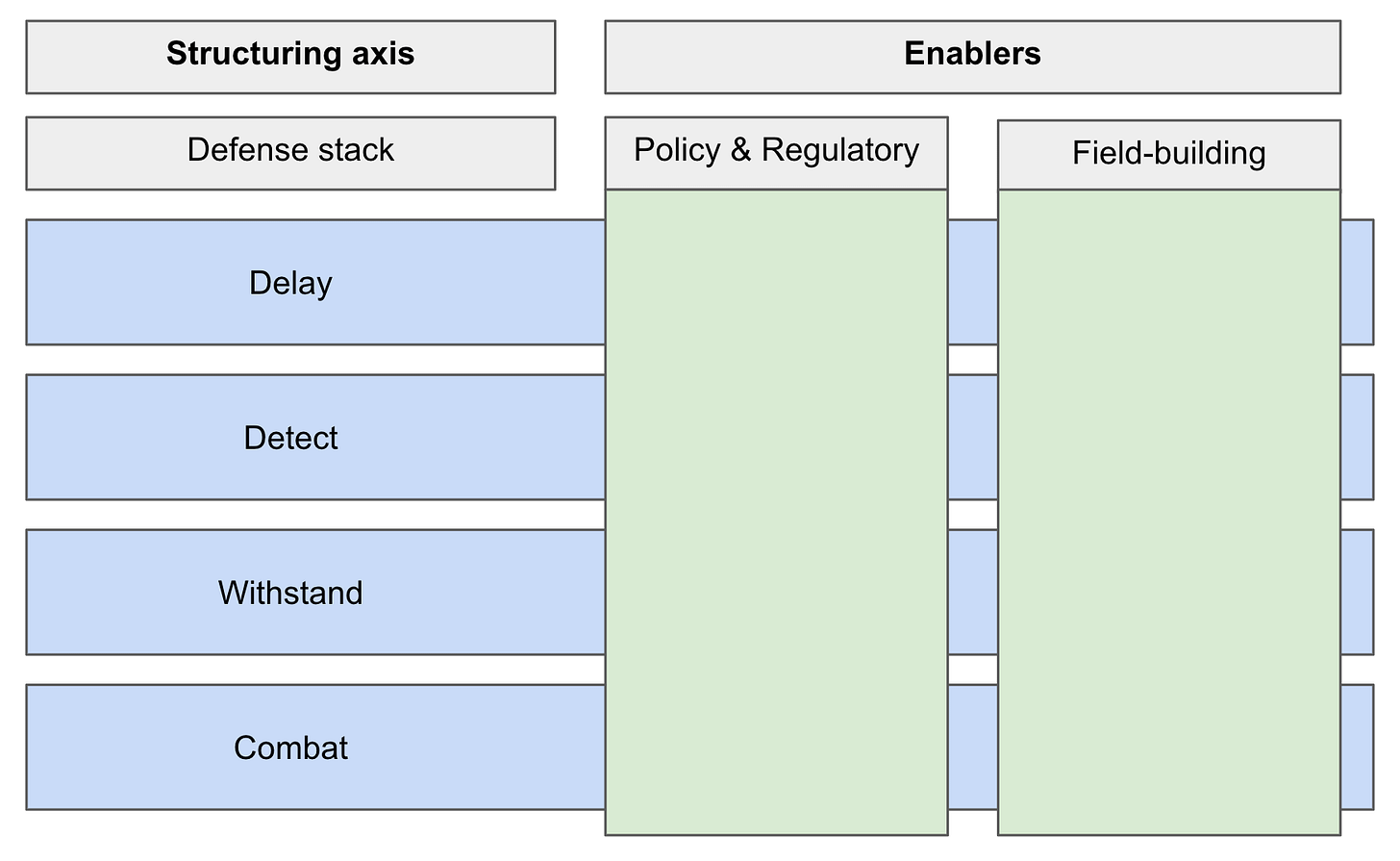
We break down global biosecurity into a stack of defense layers: Delay, Detect, Withstand, and Combat. We have also included two under-discussed enabling layers: Field-building and Policy & Regulatory. These are based on internal research and previously published strategies, such as the Four Pillars Strategy and Delay, Detect, Defend. It is also informed by reports from various governmental and independent bodies, including:
We need a well-resourced ecosystem of talent to build these defense layers in advance of a pandemic event. Massive waves of new philanthropic funding for interventions in these areas will be available to enable this.
The BlueDot Impact team has and will continue to work with experts in biosecurity to publish priority missions. By this we mean well-scoped projects, companies, or organizations that will help pandemic-proof the world. These will be based on deeper strategy work done on each of the defense layers and have funding support from us and others for those who want to build. They will be available here as missions on our website.
We directly support founders looking to build in the space through our Seed Grants program and through introductions to other funders.
On desktop, Substack allows you to click through the table of contents with the bar on the left of the screen.
If you are unfamiliar with the space: Start with the Threat Model.
If you are a builder or generalist: Explore any layer that aligns with your interests or past experience, or read the full stack.
If you are a policy expert: Explore the Policy & Regulatory layer.