
In the Greek classics, there is one meta-storyline that rises above all else: being respectful to the Gods vs. being disrespectful to the Gods. Icarus gets burned by the sun, not because he is too ambitious per se, but because he is not respectful of the divine order. A more recent example would be pro wrestling. You can tell who’s the face and who’s the heel by simply asking, “who here is respectful to wrestling, and who is disrespectful to wrestling?” All good stories take some form or other like this.
VC has its own version of this story. It goes, “VC is and has always been boutique. The mega-firms have gotten too large, and aimed too high. Their downfall is assured, because it is simply disrespectful to the game.”
I understand why people want this story to work. But the reality is, the world has changed, and venture has changed alongside it.
There is more software, leverage, and opportunity than there used to be. There are more founders building much larger companies than there used to be. Companies stay private for longer than they used to. And founders demand more from their VCs than they used to. Today, the founders building the best companies need partners who can actually roll up their sleeves and help them win, not just write checks and wait.
So the topline goal of the venture firm now is creating the best interface to help founders win. Everything else—how you staff a firm, how you deploy capital, what size funds you raise, how you help get deals done and broker power in service of founders—is downstream from that.
Mike Maples is famous for saying that your fund-size is your strategy. What’s also true is your fund-size is your belief in the future. It’s your bet on how big startup outcomes are going to be. It may have been “arrogant” to raise big funds over the last decade, but the belief was fundamentally correct. So when top firms continue to raise massive funds to deploy over the next decade, that’s them betting on the future and putting their money where their mouth is. Scaled Venture isn’t a corruption of the venture model: it’s the venture model finally growing up and adopting the characteristics of the companies they back.
In a recent podcast, the legendary Sequoia investor Roelof Botha made three claims. First, despite venture scaling, there are a fixed number of “winning” companies each year. Second, the scaling of the venture capital industry means that too much capital is chasing too few good companies—so venture doesn’t scale, and it isn’t an asset class. And third, the venture industry should be smaller, in order to correspond to the actual number of winning companies.
Roelof is one of the all-time great investors, and he’s also a great guy. But I disagree with his claims here. (And it’s worth noting, of course, that Sequoia has scaled too: it’s one of the largest VC firms in the world.)
His first claim—that there is a fixed amount of winners—is easy to disprove. There used to be ~15 companies a year that got to $100m in revenue, now there are ~150. Not only are there more winners than there used to be, but the winners are also bigger than before. While entry prices are also higher, outcomes are vastly bigger than they used to be. The ceiling for what a startup can become went from $1 billion to $100 billion to, now, a trillion dollars and beyond. In the 2000s and early 2010s, YouTube and Instagram were considered to be huge acquisitions at $1 billion: those valuations were so rare that we called companies valued at $1 billion or more “unicorns.” Now we just assume that OpenAI and SpaceX are going to be trillion-dollar companies and that several others will follow them.
Software is no longer a scrappy sector of the American economy, home to quirky oddballs that are too weird to work elsewhere. Software now is the American economy. Our largest companies, our national champions, are no longer General Electric and ExxonMobil: they’re Google, Amazon, and Nvidia. Private tech companies are equivalent to 22 percent of the S&P 500. Software isn’t done eating the world—really, thanks to the acceleration that AI is bringing, it’s just getting started—and it’s even more important than it was fifteen, ten, or five years ago. So the scale that a successful software company can achieve is bigger than it used to be.
The definition of “software company” has also changed. Capital expenditures are dramatically higher —the big AI labs are becoming infrastructure companies, owning their own data centers, power generation, and chip supply chains. Similar to how every company became a software company, every company is now becoming an AI company, and perhaps an infrastructure company too. More companies are entering the world of atoms. The lines are blurring. Companies are verticalizing aggressively, and the market potential of these vertically integrated technology conglomerates is exponentially larger than anyone imagined a pure software company could become.
Which brings us to why the second claim—that there’s too much capital chasing too few companies—is false. Outcomes are much bigger than they used to be, the world of software is much more competitive, and companies are going public at a much later stage than they used to. All of this means that great companies simply need to raise a lot more capital than they did before. Venture capital exists to invest in new markets. What we’ve learned, over and over again, is that in the long run new markets are always much larger than we anticipate. The private markets have matured enough to support the very best companies at unprecedented scale—just look at the liquidity available to top private companies today—and both private and public market investors now believe in venture outcomes being extraordinarily large. We have continually misjudged how large VC as an asset class can and should be, and venture is scaling to catch up with this reality—as well as the opportunity set. The new world demands flying cars, global satellite grids, abundant energy, and intelligence too cheap to meter.
The reality is that many of the best companies today are capital-intensive. OpenAI needs to spend billions on GPUs—more computing infrastructure than anyone else can imagine securing. Periodic Labs needs to construct automated laboratories for scientific innovation at unprecedented scale. Anduril needs to build the future of defense. And all of them need to hire and retain the best people in the world, in the most competitive talent market in history. The new guard of massive winners—OpenAI, Anthropic, xAI, Anduril, Waymo, etc.—were capital-intensive and raised big initial rounds at high valuations.
Modern tech companies routinely require hundreds of millions in capital because the infrastructure required to build world-changing frontier technology is just so expensive. In the dotcom era, a “startup” was entering an empty field, anticipating demand from consumers still waiting for their dial-up to connect. Today, startups enter an economy shaped by three decades of technology giants. Fighting for Little Tech means that you have to be ready to arm David against a handful of Goliaths. Companies in 2021 were definitely over-funded, with a larger share of dollars going into sales and marketing to sell products that weren’t 10x better. But today the money is going into R&D or capex.
So the winners are far bigger than they used to be, and they need to raise much more money than they used to, often out of the gate. So of course the venture industry has to be much bigger to meet that need. That scaling makes sense, given the size of the opportunity set. If VC was too big for the opportunities in which venture capitalists are investing, we would expect to see the largest firms see bad returns. But we haven’t seen that at all. During the same time of expansion, the top venture firms have repeatedly returned extremely strong multiples—as have the LPs who’ve been able to enter them. A famous venture capitalist used to say that you could never have a 3x return on a $1 billion fund: it was just too big. Since then, certain firms have more than 10xed a $1 billion fund. Some people point to the lower-performing firms to indict the asset class, but any power-law industry is going to have massive winners and a long tail of losers. The ability to win deals without having to win on price is why firms can have persistent returns. In other major asset classes, people sell to or take a loan from the highest bidder. But VC is the canonical asset class where you compete on other dimensions besides price. VC is the only asset class with meaningful persistence of firms in the top decile.
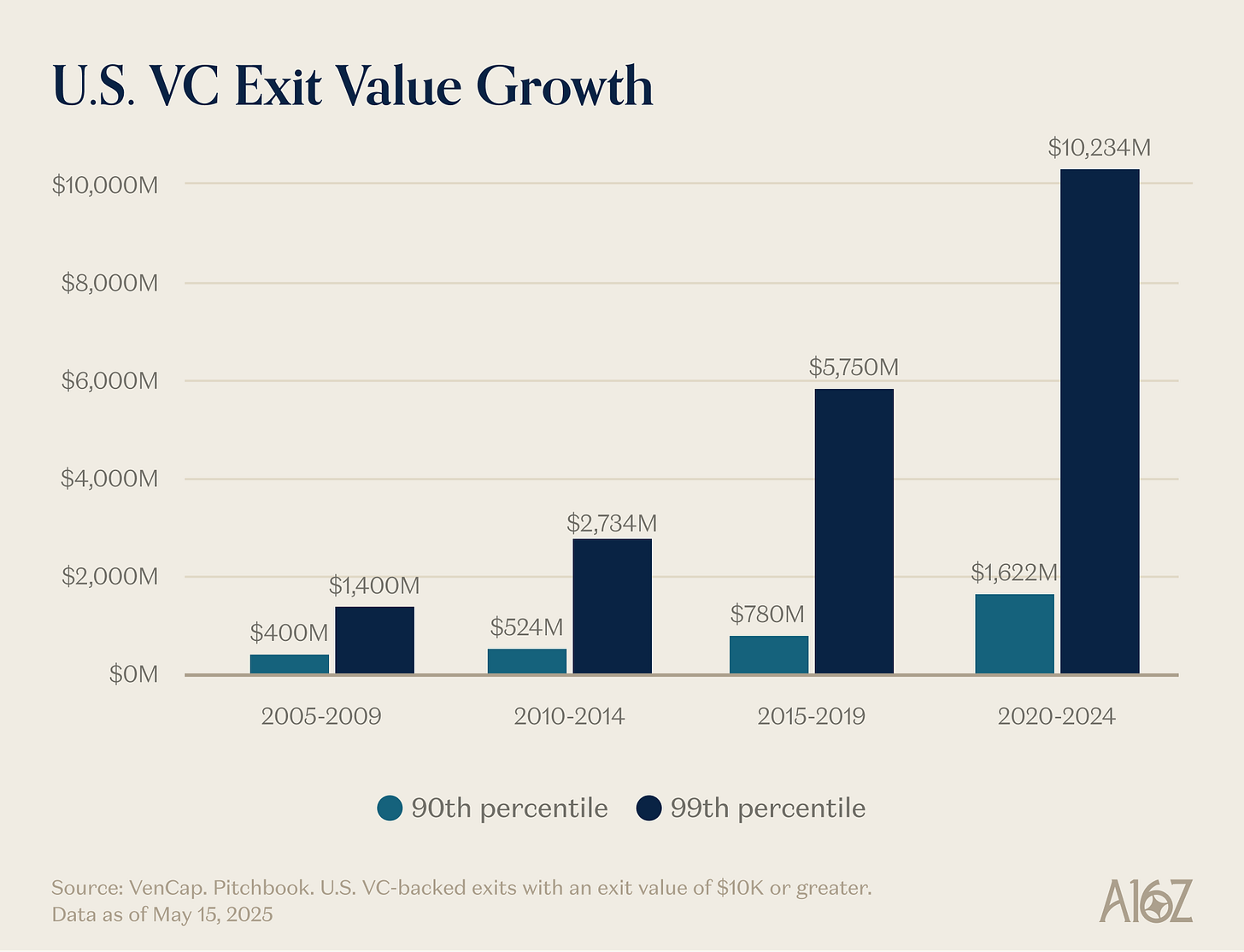
And the last point—that the venture industry should be smaller—is also false. Or, at the very least, it would be bad for the tech ecosystem, for the goal of creating more generational tech companies, and ultimately for the world. Some people complain about the second order impacts of the increase in venture capital (and there are some!) but it has also coincided with a significant increase in startup market cap. To advocate for a smaller venture ecosystem is also likely advocating for a smaller startup market cap, and also likely slower economic development as a consequence. Which might explain why Garry Tan said in a recent podcast, “venture can and should be 10x bigger than it is now.” To be sure, it might be good for any individual LP or GP if there’s no more competition and they’re the only game in town. But it’s obviously better for founders, and for the world, if there’s more venture capital than there is today.
To flesh that out further, let’s consider a thought experiment. First, do you think there should be a lot more founders in the world than there are today?
Second, if we suddenly got a lot more founders, what kind of institutions would best serve them?